I Ignored Paris's Biggest Sights for 24 Hours (Best Day Ever)
I spent a whole day in Paris actively avoiding the Eiffel Tower and the Louvre, only to find the real magic of the city in a quiet canal, a plate of sausage, and a glass of Gamay.
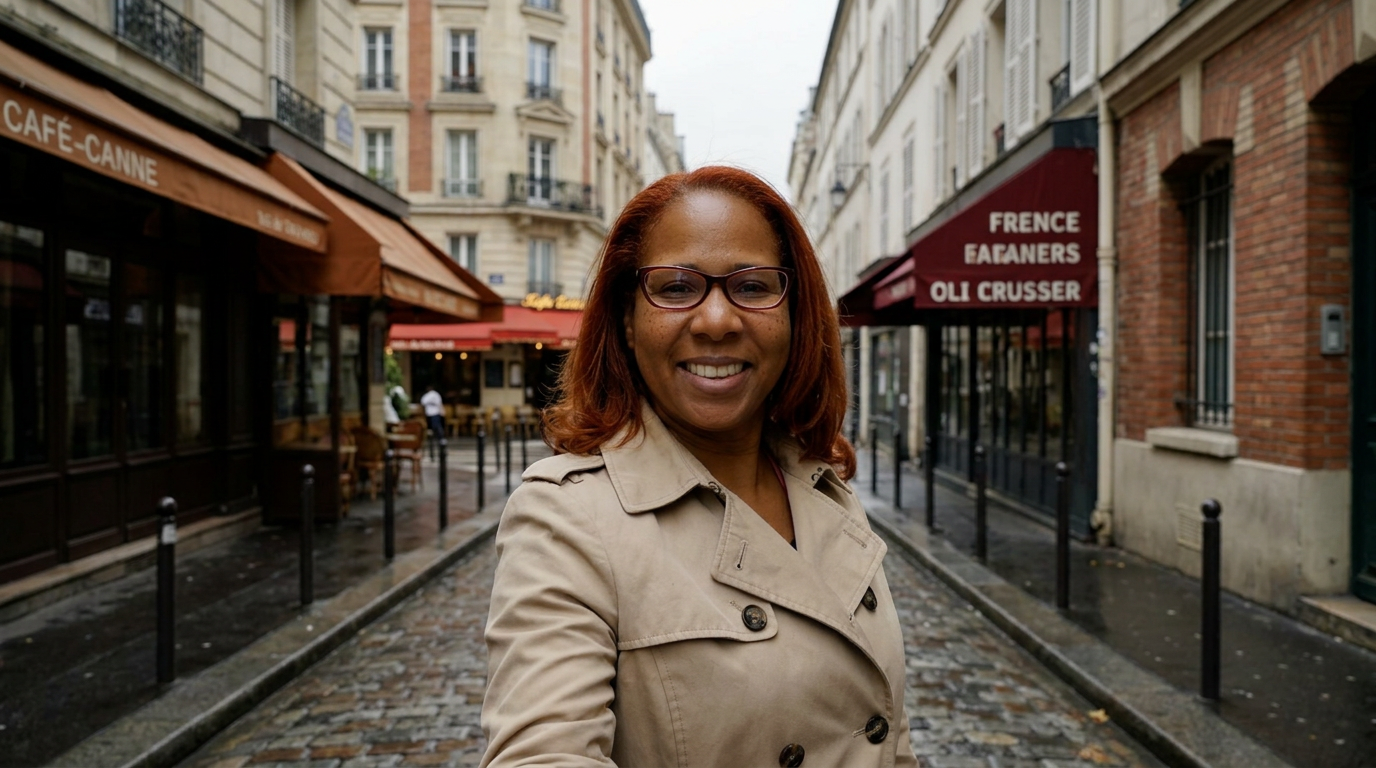
Everyone told me I had to see the Eiffel Tower, the Louvre, and the Arc de Triomphe. But today, I’m doing the unthinkable in Paris: I'm avoiding every single landmark on purpose to see what happens when you just let the city happen to you.
Handheld shot of Tara walking briskly down a narrow, sunlit stone alleyway in the 10th Arrondissement, looking back at the camera with a nervous, conspiratorial grin.
I have a confession to make. The first time I came to Paris years ago, I spent the whole time stressed. I was constantly checking my watch, rushing to catch metro lines to make museum time slots, and squinting over a sea of selfie sticks just to get a blurry glimpse of the Mona Lisa. I left feeling exhausted, detached, and honestly, a little like I’d just checked off a giant, expensive grocery list instead of experiencing a living, breathing city. My husband Tony and I flew in from Orlando yesterday, and while he decided to sleep off his jetlag at our hotel, I made a rule for myself today: no monuments, no museum tickets, and absolutely no plans.
I woke up at 7:00 AM in our tiny room in Belleville to the sound of sirens and someone rattling a metal storefront grate open downstairs. It was gray, about fifty-five degrees, and drizzling just enough to make the cobblestones slick. I wore my heaviest trench coat, a pair of worn-out sneakers, and carried nothing but a canvas tote bag with my camera, an umbrella, and my wallet. I was incredibly nervous. It feels almost disrespectful to come to one of the most famous cities in the world and deliberately ignore the things people save up their entire lives to see. What if I just ended up bored, cold, and wet in a random neighborhood?
But that’s the gamble. I wanted to see what Paris feels like when you aren’t trying to capture it for an Instagram feed. I wanted to find the quiet corners, the local grocery stores, the old men arguing over newspapers, and the real, unpolished rhythm of the streets. So, with a Metro ticket clutched in my damp palm, I headed out into the cool morning air, promising myself I wouldn’t look at a single map unless I was hopelessly lost.
My day started in Belleville, a gritty, vibrant neighborhood in the northeast of the city that tourists rarely wander into. I found a tiny boulangerie called Boulangerie Chez Virginie on a steep hill. There was no line of tourists, just school kids grabbing croissants and construction workers in orange vests getting baguettes. I bought a pain au chocolat for 1.40 Euros. The pastry was so shatteringly crisp that flakes of it rained down my coat like snow with every bite, and the chocolate inside was still warm and gooey. I ate it standing under a green awning while watching a street sweeper clear autumn leaves from the gutter with a broom made of green twigs. It was perfect.
From there, I decided to just walk south. No destination, just following whatever street looked most interesting. I ended up wandering along the Canal Saint-Martin. This isn't the grand, sweeping Seine with its tourist boats; it’s a quiet waterway lined with iron footbridges and massive chestnut trees. I sat on a damp stone quay for an hour, watching the locks slowly fill and empty to let a single, rusty barge pass through. There was an old woman sitting near me, throwing bits of a baguette to a family of ducks. She looked at me, gave a tiny nod, and said, 'Ça va?' I nodded back and smiled. 'Ça va bien.' That was it. Just two words, but I felt like I belonged there.
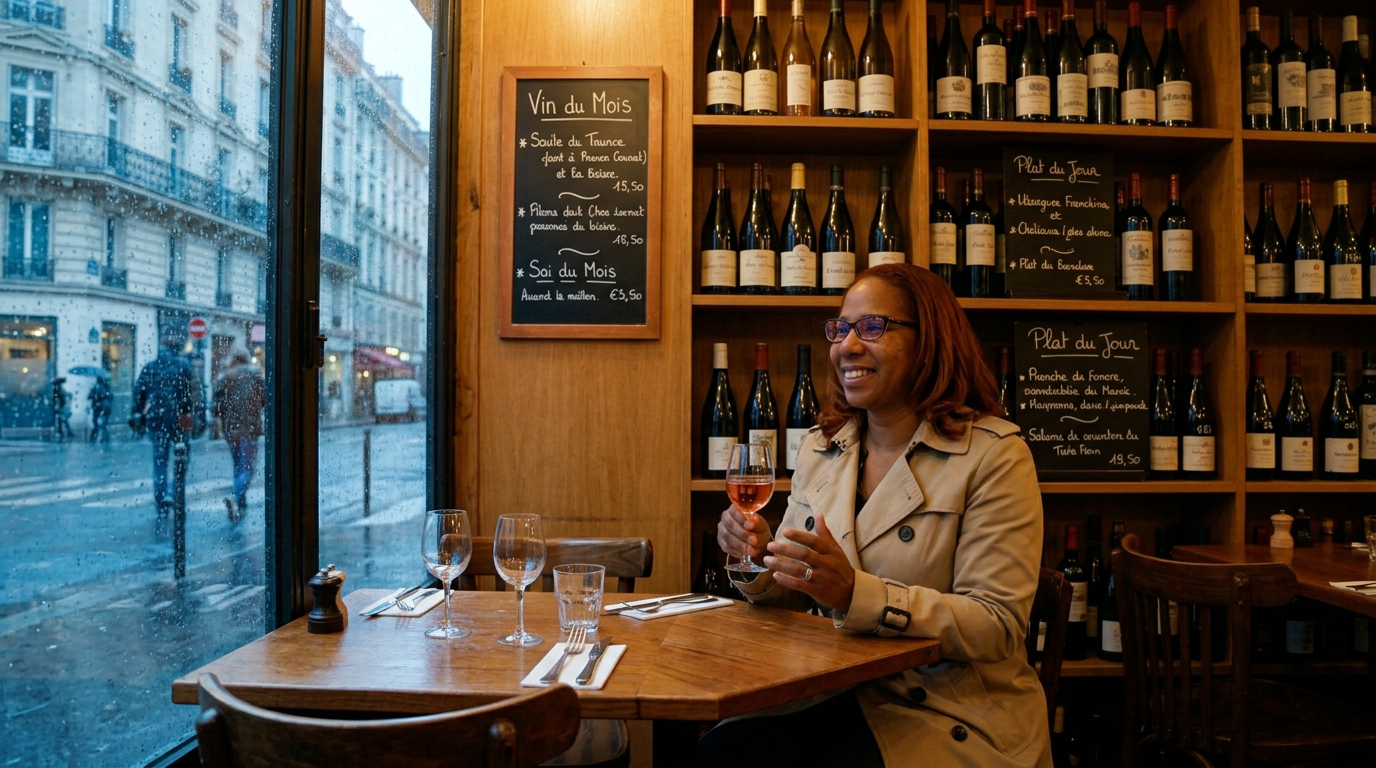
By noon, my feet were aching from the cobblestones, and the drizzle had turned into a steady, chilly downpour. I was cold, damp, and desperately needed shelter. That's when I stumbled onto Rue des Vinaigriers and saw the glowing, warm windows of a tiny bistro called Le Verre Volé. The place was packed, loud, and smelled of garlic, red wine, and roasting pork. There was a tiny wooden table right by the window that was empty. I squeezed in, my wet coat dripping onto the tiled floor, and looked at the chalkboard menu written entirely in running French script.
I didn't recognize half of it, so I just pointed to the daily special: Saucisse au couteau avec purée, which cost 18 Euros. When it arrived, it was a massive, coarse-ground sausage coiled on top of the smoothest, most butter-laden mashed potatoes I have ever seen in my life, swimming in a rich, glossy brown gravy. It was rustic, heavy, and absolutely incredible. The room was so loud with the clatter of silverware and rapid-fire French conversations that I felt completely anonymous, wrapped in this cozy blanket of Parisian lunch-hour chaos.
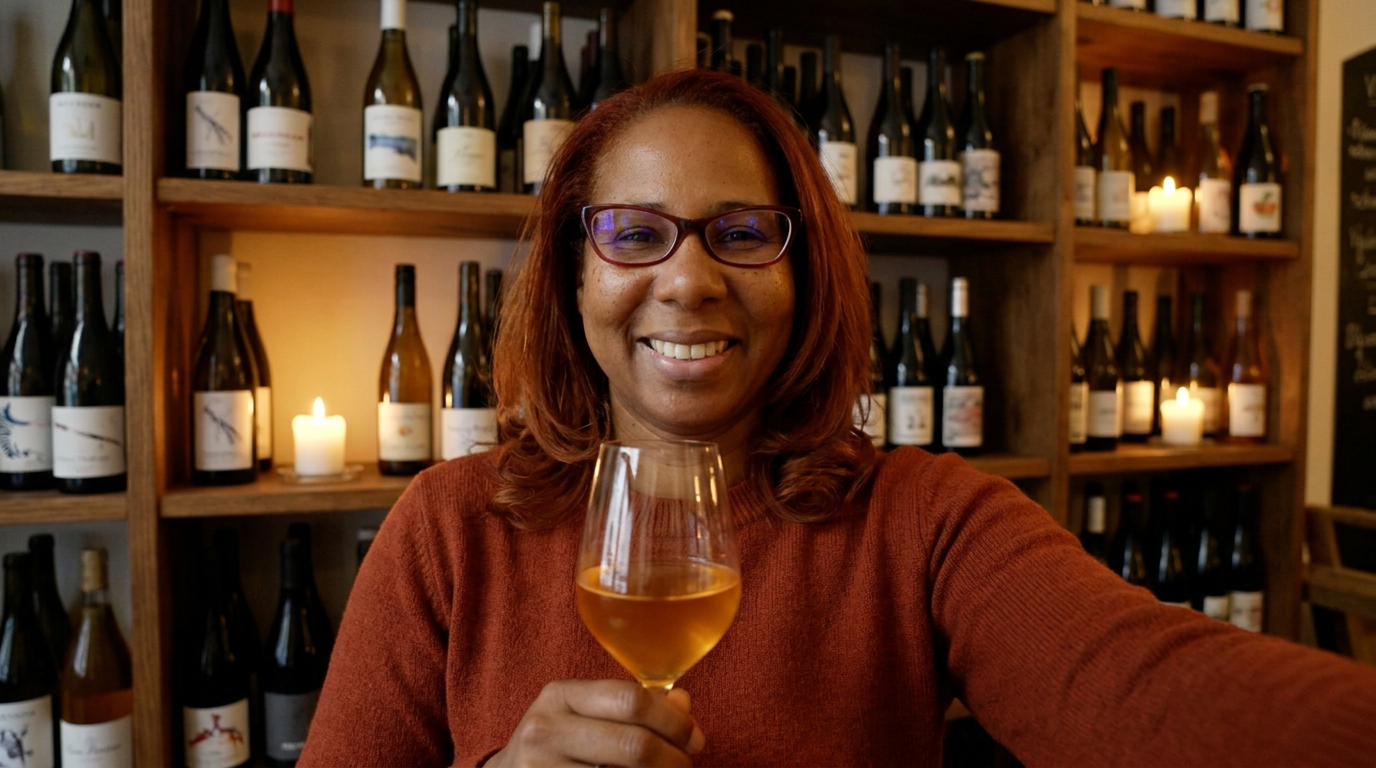
To go with the sausage, the server suggested a glass of red wine. He didn't hand me a list; he just walked me over to a wall of bottles spanning from floor to ceiling and pointed to a bottle of Gamay from the Beaujolais region, made by a natural winemaker named Karim Vionnet. It was 7 Euros for a glass. It wasn't fancy or oaky; it was bright, slightly chilled, tasted like wild raspberries and earth, and had this lively, refreshing acidity that cut right through the rich butter of the potatoes. Drinking it felt like a warm hug on a miserable day.
After lunch, the rain let up, and I decided to head further south toward the Marais. Instead of visiting a museum, I spent my afternoon looking for quiet green spaces. I found the Square Georges-Cain, a tiny, hidden courtyard garden surrounded by old stone mansion walls. It was completely silent except for the dripping water from the ivy. There were ancient Roman ruins and carved stone blocks just resting in the grass, completely open to the air, with no ropes or signs telling you not to touch them. I sat on a wooden bench, read my book, and listened to the distant hum of traffic.
Around 4:00 PM, I crossed over to the Île Saint-Louis, the quieter sister island to the one holding Notre-Dame. The sun finally broke through the clouds, casting this gorgeous, pale golden light across the limestone buildings. I walked along the Quai d'Anjou, looking down at the river below. I met an artist named Jean-Pierre who was selling watercolors from a wooden box attached to the stone wall. He didn't try to sell me anything; he just pointed out how the light reflected off the water and explained how the color of the Seine changes from green to blue depending on the sky. I bought a small, moody painting of the river from him for 20 Euros.
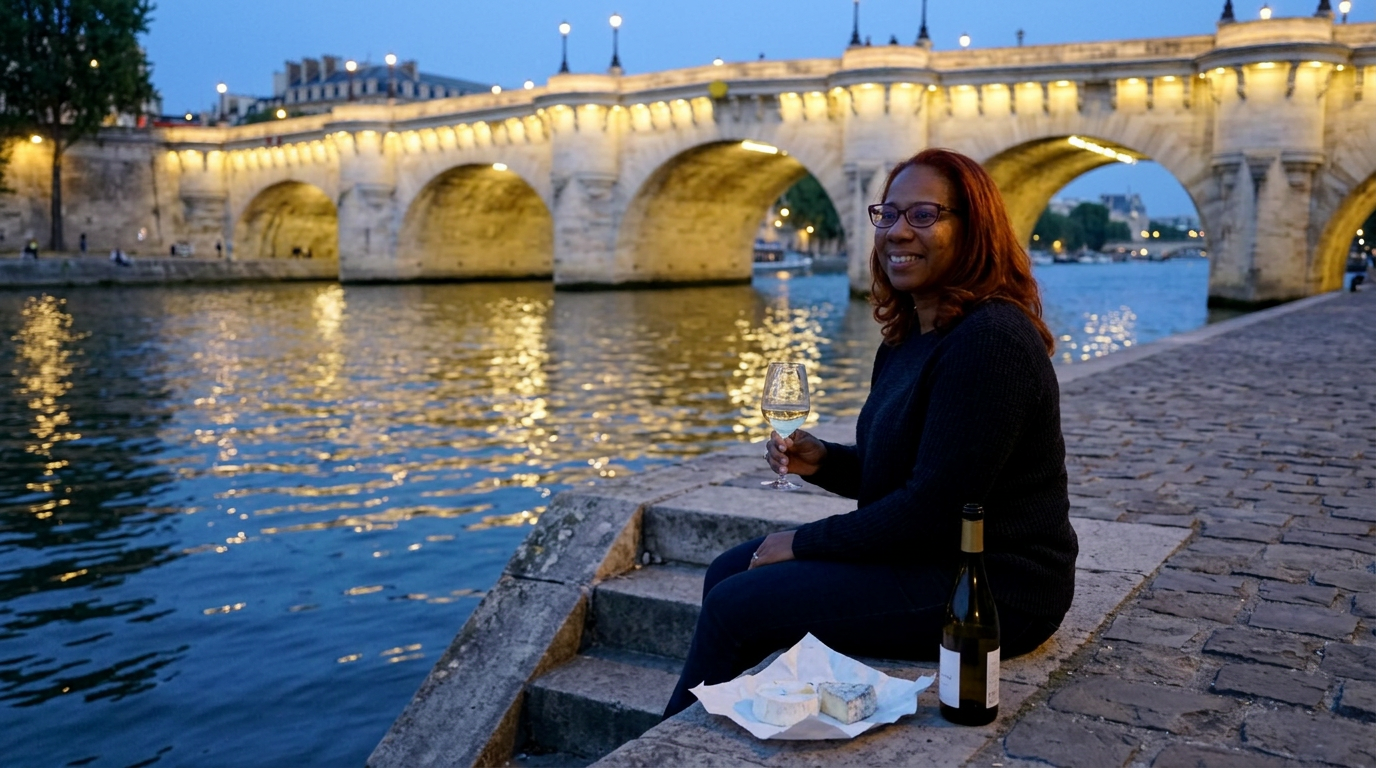
Rather than wrapping up the day at a touristy rooftop bar, I picked up a cheap bottle of Chenin Blanc from a local Nicolas wine shop for 12 Euros and a small block of Comté cheese. I walked down the stone steps of the Square du Vert-Galant, right at the western tip of the Île de la Cité. It sits low, right at the water level, pointing like the bow of a ship down the river. I pulled the cork with my travel pocketknife, poured the wine into a paper cup, and watched the sky turn from gold to deep violet over the Pont Neuf.
Show Tara walking through narrow passages, looking up at residential balconies, stepping over puddles, laughing during lunch, and clinking her paper cup toward the river at twilight.
As the streetlights started flickering on along the bridges, casting long, wavering yellow reflections on the dark water, I realized something. I hadn't seen the Eiffel Tower light up. I hadn't stood in a three-hour line. I hadn't spent a single Euro on an admission ticket. But as I sat there on the cold stone, drinking bright, pear-scented Loire Valley wine and eating nutty cheese, I felt closer to Paris than I ever had before. I wasn't just observing the city; I was living in it, even if just for a day.
If you are planning a trip here, my advice is simple: give yourself permission to miss things. Let go of the pressure to see the 'must-see' list. Skip the giant museums for a afternoon, get off at a metro stop you’ve never heard of, find a quiet bistro, order the daily special, and just watch the world go by. Paris isn't defined by its monuments; it's defined by the space between them. It’s in the smell of yeast from a baker's oven, the clink of glasses on a sidewalk, and the quiet magic of a rainy afternoon by the canal.
I walked back to the hotel to meet Tony for dinner, my feet throbbing but my heart completely full. Tomorrow we might do some of the classic sights together, but this quiet, wet, beautiful day of getting lost will always be the Paris I remember.
A slow, atmospheric zoom out as the lights of the Pont Neuf glow in the dusk, with Tara’s silhouette visible resting against the stone wall of the riverbank, looking out over the water.
Shot List
| Type | Description | Audio | Duration |
|---|---|---|---|
| Wide | Establishment shot of a quiet, gray Parisian street in Belleville early in the morning, misty wet cobblestones reflecting the dim sky. | Ambient sounds of distant city traffic, a siren, and a metallic shop grate being rolled up. | 5s |
| Close-up | A fresh, flaky pain au chocolat being pulled apart, steam rising slightly from the dark chocolate center. | A loud, satisfying crunch of pastry layers breaking. | 4s |
| Medium | Tara standing under a green awning, wearing a trench coat, happily eating her pastry while watching the street. | TARA: 'This is Belleville. No tourists, just the smell of butter and cold rain. It’s perfect.' | 7s |
| B-roll | A green iron bridge over the Canal Saint-Martin with yellow chestnut leaves drifting down into the green water. | The rushing sound of water pouring through a canal lock gate. | 6s |
| Detail | An old woman's hands tossing breadcrumbs to mallard ducks floating near the stone canal wall. | Soft quacking and the gentle splashing of water. | 5s |
| Medium | Tara walking through the glass door of Le Verre Volé, stepping into a warm, bustling, crowded dining room. | A wave of warm bistro noise: clinking glasses, laughter, and rapid French dialogue. | 6s |
| Overhead | A steaming plate of coiled craft sausage sitting on top of a mountain of silky smooth mashed potatoes and rich gravy. | The scrape of a fork picking up a perfect bite of sausage and potato. | 5s |
| Close-up | A clear glass being filled with bright red, slightly chilled Gamay wine in front of a floor-to-ceiling wine wall. | The glug-glug sound of wine pouring from a bottle. | 4s |
| Medium | Tara sitting at the window table, taking a sip of the wine, closing her eyes, and smiling warmly. | TARA: 'It’s bright, it’s alive, and it tastes exactly like wild berries. It makes the rain outside completely disappear.' | 8s |
| B-roll | Slow tracking shot through the quiet, vine-covered ruins and stone walls of the Square Georges-Cain. | The gentle patter of raindrops on ivy leaves and distant, muffled traffic. | 6s |
| Medium | Jean-Pierre, an elderly French artist, smiling and gesturing with a watercolor brush near his display box by the Seine. | JEAN-PIERRE: 'The river, she is never the same color twice. Today, she is silver.' | 7s |
| Detail | Tara using a pocketknife to pull the cork out of a wine bottle while sitting on a stone wall by the river. | The squeak of the cork and a satisfying 'pop' as it comes free. | 5s |
| Wide | The sun setting behind the Pont Neuf, painting the clouds in shades of pale violet and orange over the water. | The low hum of the city and the gentle lapping of the Seine against the stone banks. | 8s |
- Capture close-up details of hands: peeling pastry, holding a damp metro ticket, uncorking the wine bottle, and touching the rough, historic stone walls.
- Film the motion of the water in the canals and the river—specifically how the autumn leaves debris floats and how the light reflects off the ripples.
- Get shots looking straight up at the apartment buildings, capturing the wrought-iron balconies and the chimneys against the gray sky to show the texture of residential Paris.
- Record high-quality ambient audio at every location: the crunch of the pastry, the loud chatter of the bistro, and the wind rustling the trees along the water.
- 0:00 — An nostalgic, warm, and slightly whimsical acoustic guitar and accordion melody starts, establishing a cozy, classic French atmosphere.
- 1:30 — The music fades down to quiet, low-fi jazz piano chords as she walks through the quiet streets of Belleville.
- 3:15 — A lively, upbeat gypsy-jazz guitar track kicks in as she enters the busy bistro, matching the high energy and clatter of lunch.
- 5:45 — The music transitions back to a slow, reflective solo acoustic guitar as she wanders the quiet gardens and meets the artist.
- 7:30 — A warm, atmospheric indie-folk track with soft strings begins to build as the sun breaks through the clouds at the river.
- 9:15 — The music swells into a beautiful, gentle orchestral swell during the sunset reflection, slowly fading out to silence as the video ends.
- Keep the pacing of the edit relaxed to match the theme of slowing down; avoid fast, jagged cuts or hyperactive transitions.
- Use warm, slightly desaturated color grading to emphasize the cozy autumn tones (oranges, grays, and warm wood) over bright, synthetic colors.
- When displaying the prices or locations on screen, use a clean, minimalist, handwritten-style font that feels like a personal travel journal.
- Make sure the transitions between the loud bistro scenes and the quiet garden scenes have a stark, intentional audio contrast to highlight the variety of the city's spaces.
| Call | Provider | Model | Input Tokens | Output Tokens | Compute / Credits |
|---|---|---|---|---|---|
| Script | abacus.ai | gemini-3.5-flash | 1,557 | 4,590 | — |
| Image 1 — The Rebellion Begins | abacus.ai | nano_banana2 | — | — | 6,789.1 |
| Image 2 — Bistrot Refuge | abacus.ai | nano_banana2 | — | — | 6,789.55 |
| Image 3 — Sunset by the Seine | abacus.ai | nano_banana2 | — | — | 6,789.4 |
I Woke Up at 5 AM for Prague’s Charles Bridge (And Why You Should Too)
I got up at five in the morning to see the most famous bridge in Europe completely empty, and it made me fall in love with a city I thought was too crowded for me.
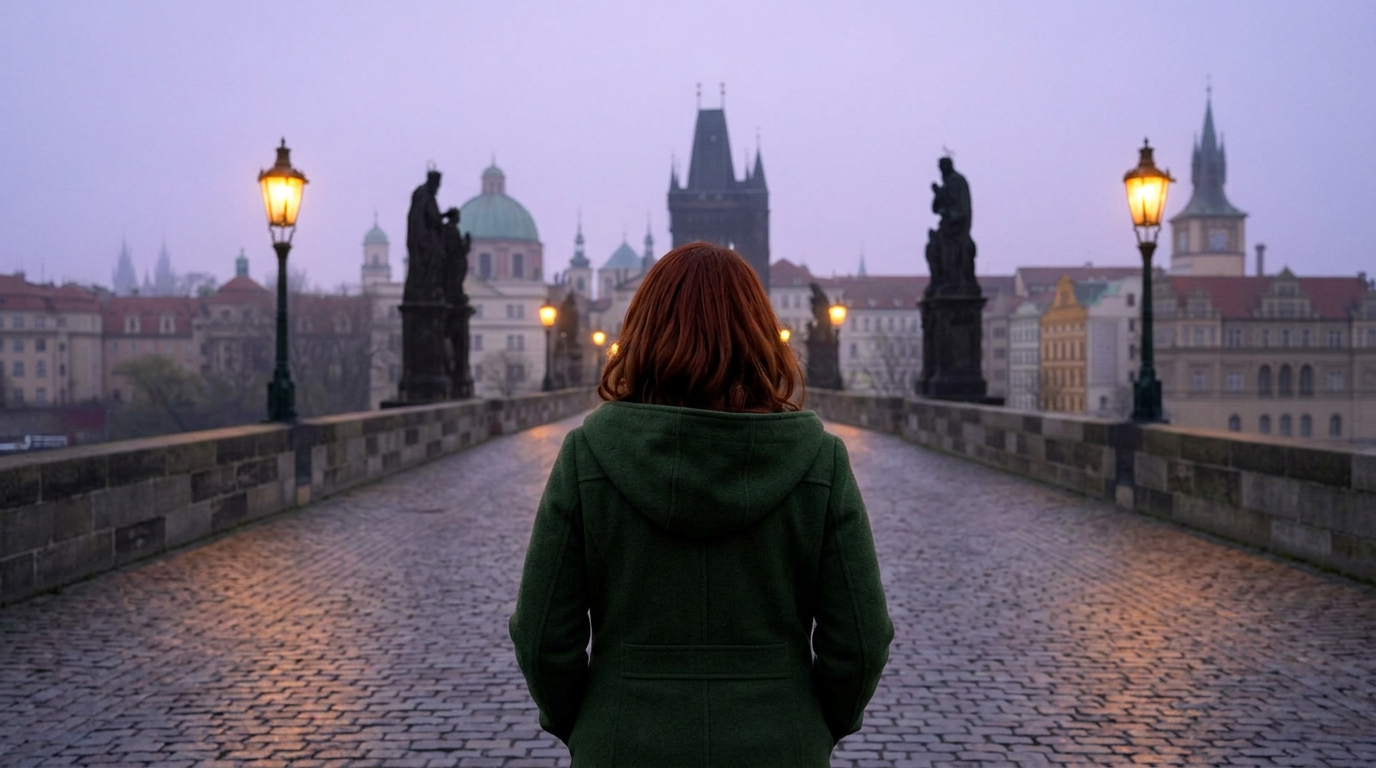
Everyone told me Prague was too crowded, that the magic was buried under millions of selfie sticks. But they didn't tell me what happens if you show up at five in the morning, when the fog is still rising off the Vltava River.
Handheld, slightly shaky camera walking through a silent, misty Charles Bridge at dawn. The streetlights are still on, casting a warm orange glow on the cobblestones. Tara is in a dark green coat, looking back at the camera with her hood up, whispering.
I have a confession to make: I was terrified of coming to Prague. Tony and I have been planning this trip to Central Europe from our home base in Orlando for months, but the closer we got, the more people warned me. 'It's like Disneyland for adults, Tara,' they said. 'You won't be able to move on the Charles Bridge.' I hate crowds. They make me anxious, and when I'm anxious, I don't observe—I just try to survive. So, last night in our tiny apartment in the Malá Strana district, which cost us about 130 US dollars a night, I made a deal with myself. I set my alarm for 4:45 AM.
When that alarm went off, it was pitch black and forty-two degrees outside. Tony rolled over, muttered something about sleep, and pulled the duvet over his head. I don't blame him. But I dragged myself up, threw on my heaviest wool coat, grabbed my trusty leather backpack, and slipped out the door. The streets of Malá Strana, usually packed with tourists buying trdelník pastry, were completely, eerily dead. Just the sound of my own boots squeaking on the damp cobblestones and the occasional hiss of a distant tram.
My plan for the day was simple but ambitious. I wanted to see if the real, soul-stirring Prague still existed behind the postcard facade. To do that, I was going to push past my comfort zone. I’d walk the empty historic center, navigate the local tram system to find a hidden hilltop park, eat a heavy, traditional Czech lunch at an old-school basement tavern, and end my day exploring the emerging natural wine scene in the trendy Karlín neighborhood. I was nervous about the language barrier, the legendary grumpiness of local waiters, and honestly, just staying awake until sunset.
Stepping onto the Charles Bridge at 5:15 AM was like walking into a 19th-century oil painting. The gothic towers at either end were silhouetted against a pale, lilac sky. There were maybe six other people on the entire path—a lone photographer with a tripod, a jogger, and three seagulls waiting for a handout. The thirty baroque statues lining the balustrades looked like silent sentinels watching over the river. The air tasted clean and cold. It was the first time in years I felt a city actually breathe. I sat on a stone ledge, my fingers freezing, and just watched the sun slowly paint the Prague Castle gold. I earned this silence.
By 8:00 AM, the spell was breaking. The first tour groups were trickling in, so I headed off the beaten path. I walked back toward Malá Strana and found the entrance to the Wallenstein Garden. It’s free to enter, but most people walk right past the modest wooden gate. Inside, it’s a baroque paradise with manicured hedges, giant white peacocks just roaming the lawns, and this bizarre, dripping artificial stalactite wall that looks like something out of a fantasy novel. I sat on a bench, ate a cold apple I’d packed from the apartment, and watched a gardener prune roses in the crisp morning light.
By 10:30 AM, my feet were aching, and I needed to get across town. Instead of taking an expensive taxi, I decided to tackle the tram. Prague’s transit system is incredibly efficient, but the ticket machines can be intimidating. I stood at the Újezd stop for ten minutes, staring at the yellow terminal, trying to figure out how to buy a 30-minute ticket for 30 Czech Koruny—about a dollar and thirty cents. A lovely older woman with brilliant purple hair saw my confusion, tapped her own contactless card on the validator inside the tram to show me how it worked, and smiled. 'Easy,' she said in English. And it was. I took the Line 22 tram up the hill to Letná Park.
Letná Park is where the locals go to escape the tourist madness, and the view from the Hanavský Pavilion is spectacular. You can see all of Prague’s bridges lined up over the Vltava like a row of dominos. I walked through the autumn leaves, watching dogs chase tennis balls and young couples drinking coffee on park benches. It was a stark contrast to the hectic Old Town Square I had bypassed below. I could feel my shoulders dropping. I wasn’t just a spectator anymore; I was part of the rhythm of the city.
By 1:00 PM, my stomach was screaming for food. I wanted something authentic, not a tourist trap with English menus laminated in plastic. I found U Černého Vola—The Black Ox—a legendary pub up near the castle that has been serving beer and simple food for decades. The room was dark, wood-paneled, and filled with the loud, echoing chatter of Czech construction workers and old men. The air smelled of hops and roasted pork. There are no reservations. You just squeeze onto a long communal wooden bench and wait for the waiter, who did indeed look delightfully grumpy.
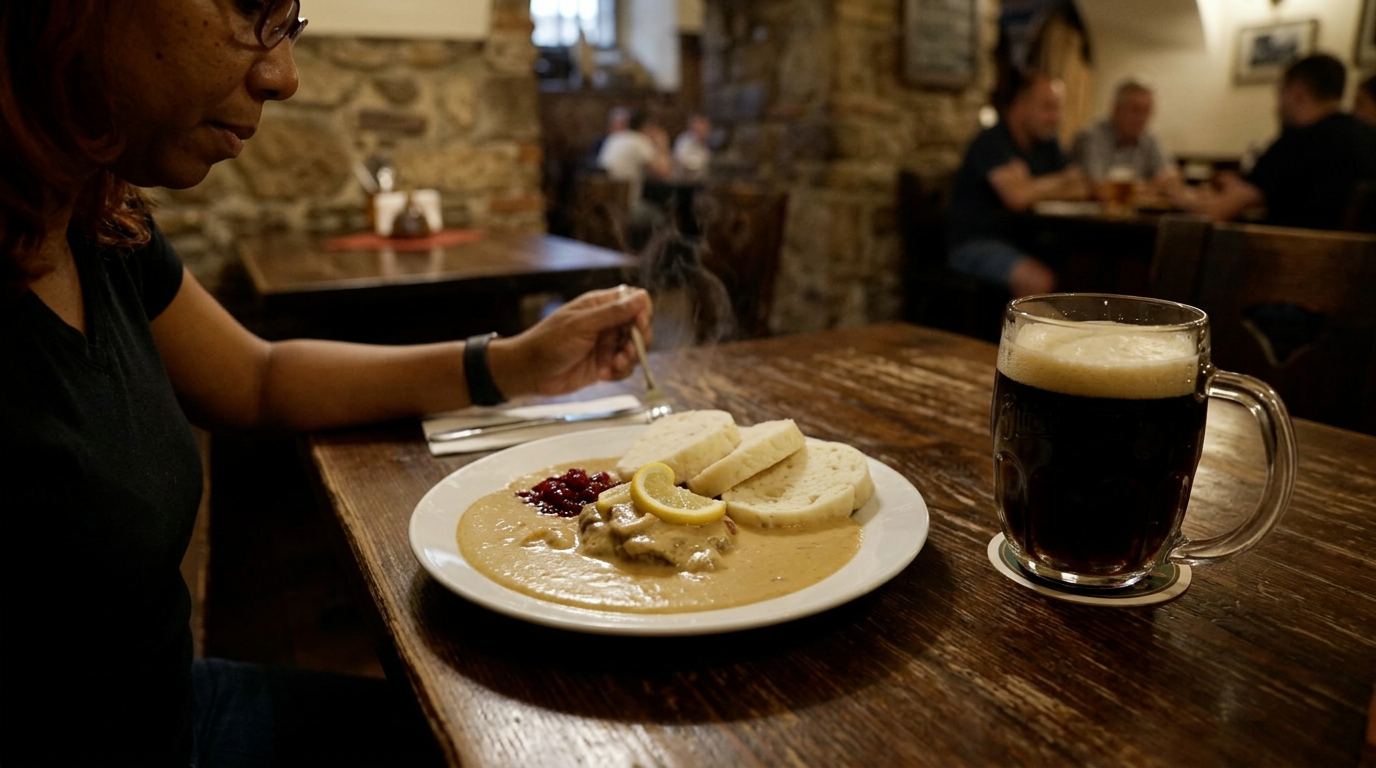
I ordered the '*'Svíčková na smetaně'*'—beef sirloin in a rich, creamy root vegetable sauce, topped with cranberries, a slice of lemon, and a mountain of fluffy bread dumplings. It cost 180 Koruny, about eight dollars. When the plate arrived, it looked like a hug on a plate. The beef was so tender it fell apart with a fork, and the sauce was a perfect balance of sweet, savory, and tart. I used the dumplings to mop up every single drop. The waiter gave me a nod of approval when he cleared my clean plate. I think I earned his respect.
To shake off the heavy lunch, I spent the afternoon wandering through the Jewish Quarter, Josefov. It’s a somber, beautiful neighborhood with a tragic history, but the architecture is breathtaking. I bought a combined ticket to the Jewish Museum for 350 Koruny and spent two hours quiet and reflective, looking at the drawings of children from the Terezín concentration camp kept in the Pinkas Synagogue. It was a heavy afternoon, but incredibly important. Travel shouldn’t just be about pretty views; it’s about holding space for the history of the ground you're walking on.
As the sun began to set, casting a warm orange glow over the Vltava, I crossed back over the river. It was time for my favorite part of any trip: exploring the local wine culture. Czech wine doesn't get exported much to the US, so I was dying to try it. I headed to Veltlin, a cozy natural wine bar in the hip Karlín neighborhood, which felt miles away from the historic center. The walls were lined with bottles, and there was no wine list—the server just talks to you about what you like and pours something unique.
The sommelier poured me a glass of Veltlínské Zelené, which is Grüner Veltliner, from the Moravia region in the south of the country. It cost about 120 Koruny, or five dollars. It was bone-dry, slightly cloudy, with this amazing peppery finish and a hint of green apple. Drinking it in this bustling, candlelit room full of young locals chatting after work, I realized this is the Prague I was looking for. It wasn't dead, and it wasn't a theme park. It was alive, modern, and incredibly welcoming if you just knew where to look.
A montage of visual contrasts: the quiet, foggy morning light shifting into bright, sunny park scenes, the rich textures of the heavy Czech lunch, the solemn beauty of the Jewish cemetery, and the warm, candlelit glow of the natural wine bar in the evening.
By 8:00 PM, I was exhausted but incredibly happy. Walking back across the Legion Bridge, looking at the illuminated Prague Castle in the distance, I felt a deep sense of accomplishment. I had started the day nervous about crowds and language barriers, but by simply changing my clock and being willing to get lost, I found a city of quiet gardens, warm dumplings, and cutting-edge wine.
If you are planning a trip to Prague, my biggest piece of advice is simple: buy an eye mask, set your alarm for dawn at least once, and don't be afraid to leave the Old Town. Go to the parks, ride the trams, and seek out the neighborhood wine bars. Prague is only a tourist trap if you refuse to look past the main square. The real magic is waiting for you—you just have to wake up early enough to find it.
Tara standing on the Legion Bridge at night, the city lights reflecting in the river behind her. She smiles warmly at the camera, zips up her coat against the evening chill, and walks away into the golden-lit street, disappearing into the Prague night.
Shot List
| Type | Description | Audio | Duration |
|---|---|---|---|
| Wide | The Charles Bridge enveloped in morning fog at 5:15 AM. The gothic towers silhouette against a soft violet sky. | [Ambient sound of river water gently lapping and distant foghorns] | 6s |
| Medium | Handheld shot of Tara walking toward the camera on the empty bridge, shivering slightly, her breath visible in the cold air. | Tara (whispering): It is exactly five-fifteen in the morning, it is forty-two degrees, and I have the most famous bridge in Europe entirely to myself. | 8s |
| Detail | Extreme close-up of a stone saint statue on the bridge, glistening with morning dew. | [Soft acoustic guitar music begins to swell gently] | 4s |
| B-roll | Sunlight finally hitting the golden spires of Prague Castle in the distance, cutting through the river mist. | Tara (VO): They told me Prague was too crowded. But they didn't tell me about this hour. | 7s |
| Medium | Tara entering through the wooden gates of the Wallenstein Garden, looking around in awe. | Tara: This is Wallenstein Garden. It's completely free, and almost nobody is here. | 6s |
| Close-up | A brilliant white peacock walking across the manicured green lawn of the baroque garden. | [Sound of bird rustling leaves] | 5s |
| Overhead | Looking down at a yellow tram arriving at the Újezd stop, with autumn leaves blowing along the tracks. | [Screech of tram brakes on metal tracks] | 5s |
| Medium | Tara inside the tram, successfully tapping her credit card on the orange validator machine and smiling in relief. | Tara: Okay, transit system conquered. We are heading up to the hills. | 7s |
| Wide | Pan across the city from Letná Park, showing all the bridges over the Vltava River lined up under a bright blue sky. | [Upbeat, light indie instrumental music playing] | 8s |
| Medium | Tara sitting at a long communal table inside the rustic, dark wooden tavern U Černého Vola. | Tara: It smells like decades of beer and slow-roasted pork in here. It's perfect. | 6s |
| Close-up | A steaming plate of Svíčková sirloin being set down, showing the thick cream sauce, cranberries, and dumplings. | [Clatter of heavy ceramic plates and ambient pub chatter] | 6s |
| Detail | Tara using a piece of fluffy bread dumpling to sweep up the rich vegetable cream sauce from her plate, taking a bite. | Tara: Oh my goodness. It’s sweet, savory, and tastes like the ultimate comfort food. | 8s |
| B-roll | Slow tracking shot through the old Jewish Cemetery, showing the ancient headstones crowded together under the trees. | [Music transitions to a solemn, quiet piano melody] | 7s |
| Medium | Inside Veltlin natural wine bar, the sommelier pouring a cloudy white wine into Tara's glass under warm pendant lighting. | Sommelier: This is from Moravia, skin-contact Grüner Veltliner. Very typical for our region. | 8s |
| Close-up | Tara taking a sip of the wine, nodding in appreciation, and describing it to the camera. | Tara: It's peppery, dry, and tastes like fresh green apples. It's absolutely delicious. | 7s |
| Wide | Tara standing on the Legion Bridge at night, looking back at the illuminated Prague Castle sparkling in the dark sky. | Tara: Don't let the crowds scare you away. Set that alarm, get lost, and let Prague surprise you. I'll see you on the next adventure. | 9s |
- Shoot early morning footage with a wide-angle lens to emphasize the emptiness of the bridge and the grandeur of the gothic architecture.
- Capture plenty of street-level details: the textures of the cobblestones, the movement of the old tram cars, and local life in the parks away from tourists.
- When filming food and wine, keep the focus tight and shallow to make the dishes look warm, inviting, and highly detailed.
- Incorporate the changing light throughout the day, transitioning from the cool, blue tones of dawn to the golden hour in Letná Park, and finally the warm candlelit interiors of the wine bar.
- 0:00 — Ethereal, low ambient synth pads to match the quiet, foggy dawn atmosphere of the Charles Bridge.
- 1:30 — A soft, acoustic folk guitar track begins, adding warmth as Tara describes her plans and the journey ahead.
- 3:15 — Light, whimsical instrumental music with pizzicato strings as Tara navigates the Prague tram system.
- 5:00 — Rich, upbeat accordion and acoustic guitar tune, reflecting the rustic and lively energy of the traditional Czech pub.
- 6:45 — Subtle, minimalist piano chords during the reflective walk through the historic Jewish Quarter.
- 8:15 — Warm, modern atmospheric indie-pop track with a gentle beat as Tara enjoys the natural wine bar and wraps up her day.
- Keep the pacing slow and observational during the dawn segment to let the viewer feel the silence and scale of the empty bridge.
- Use quick, rhythmic cuts during the tram ride and the walk through the park to show movement and the vibrant, bustling side of the city.
- Color grade the morning scene with cool, desaturated blues and purples, shifting to warm, golden, and amber tones for the pub, park, and wine bar segments.
- Keep on-screen text overlays minimal; use clean, elegant sans-serif fonts only for price conversions (e.g., '180 CZK / $8 USD') and location names.
| Call | Provider | Model | Input Tokens | Output Tokens | Compute / Credits |
|---|---|---|---|---|---|
| Script | abacus.ai | gemini-3.5-flash | 1,564 | 4,859 | — |
| Image 1 — The Dawn Awakening | abacus.ai | nano_banana2 | — | — | 6,789.9 |
| Image 2 — The First Sip of Moravian Wine | abacus.ai | nano_banana2 | — | — | 6,789.65 |
| Image 3 — A Comforting Czech Lunch | abacus.ai | nano_banana2 | — | — | 6,850.2 |
I spent 24 hours in Tokyo without leaving just ONE neighborhood
I decided to escape the Tokyo overwhelm by picking a single, quiet neighborhood and refusing to leave it for an entire day.
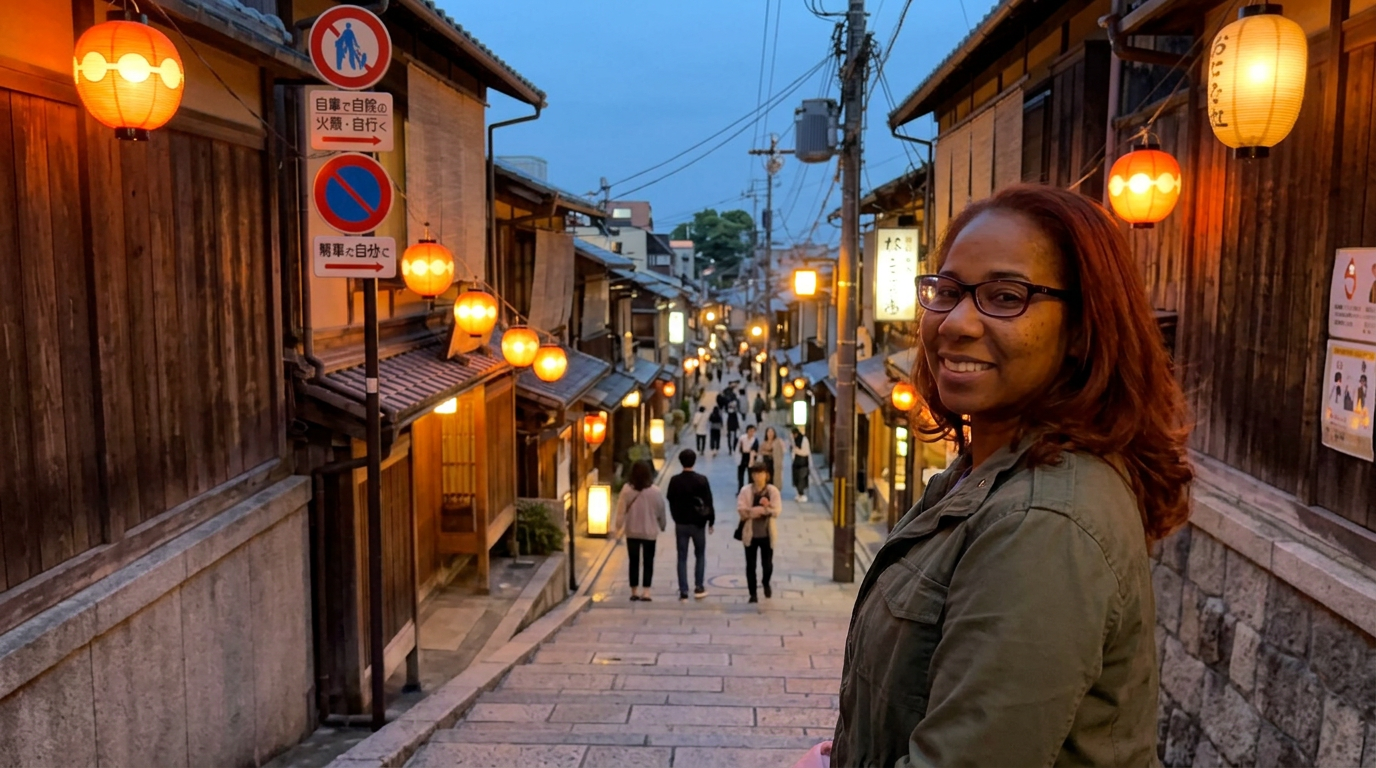
Everyone tells you to cross the Shibuya Scramble and ride the bullet train, but today, I'm doing the exact opposite. I picked one quiet neighborhood in Tokyo, and I'm not leaving it for the next twenty-four hours.
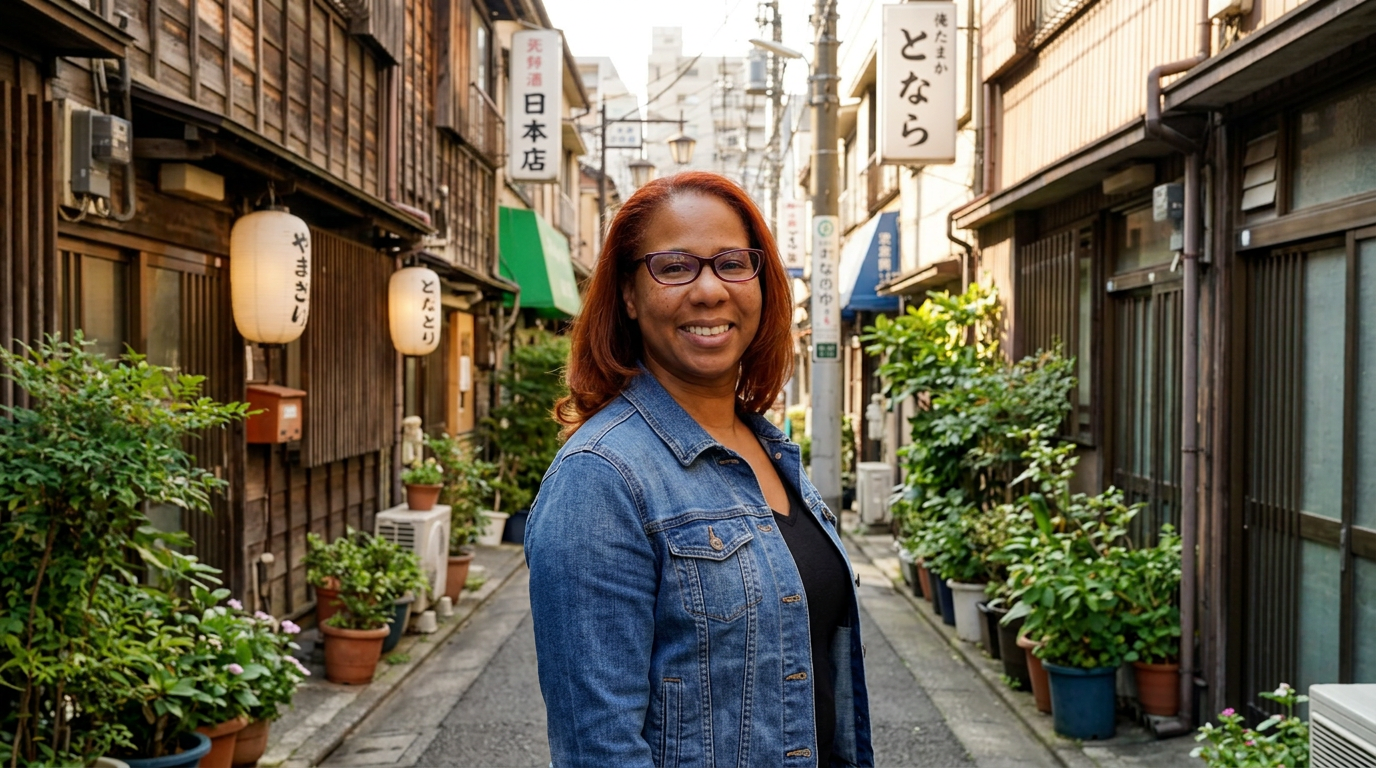
Handheld shot of Tara standing on a narrow, quiet street in Yanaka. The morning sun is low, casting long shadows. She is wearing a light denim jacket, carrying a small canvas tote bag, and looking slightly nervous but excited.
When Tony and I first talked about coming to Tokyo, I felt this massive wave of anxiety. It is the biggest metropolitan area in the world, and every itinerary I found online felt like a military campaign. Change trains three times, see five shrines before noon, eat standing up, repeat. It felt less like traveling and more like a high-speed chore. So, we made a deal. Tony wanted to go hunt down vintage camera gear in Akihabara, and I wanted to see what happens when you just... stop moving. I decided to spend a full day entirely on foot in Yanaka, one of Tokyo's oldest and most historic residential neighborhoods.
Yanaka is part of Tokyo's 'shitamachi'—the old down-to-earth flatlands that miraculously survived both the firebombings of World War II and the Great Kanto Earthquake of 1923. While the rest of Tokyo shot up into the clouds with neon and chrome, Yanaka stayed low, quiet, and residential. I set out from our tiny hotel at 8:30 AM with nothing but my camera, a coin purse filled with Yen, and a serious lack of direction. The air was crisp, about fifty-five degrees, and the only sound was the rhythmic 'shhh-shhh' of an elderly woman sweeping the street outside her wooden home.
My plan was deceptively simple: no trains, no taxis, and no frantic Google Maps navigation. I wanted to see if I could find the soul of this giant city by looking at it through a magnifying glass instead of a telescope. But as I took my first turn down an alleyway so narrow my shoulders could almost touch both sides, I realized I had no idea where the main street was, my Japanese was limited to about six polite phrases, and most of the shops didn't even have signs in Roman letters. I was officially lost, exactly four minutes after leaving my hotel lobby.
I started my morning by wandering into Yanaka Cemetery. Now, I know a graveyard sounds like a strange place to start a vacation day, but in Tokyo, this is actually a beautiful, tree-lined park where locals walk their dogs and cherry blossoms drift in the spring. It was incredibly peaceful. I walked past hundreds of traditional, towering stone graves, watching the crows circle overhead. I met an old man who was meticulously cleaning a family headstone with a small brush. He looked up, gave me a warm, toothy smile, and bowed. I bowed back, muttered a quiet 'Ohayou gozaimasu,' and felt my shoulders drop about three inches. The frantic energy of Tokyo's busy stations felt a million miles away.
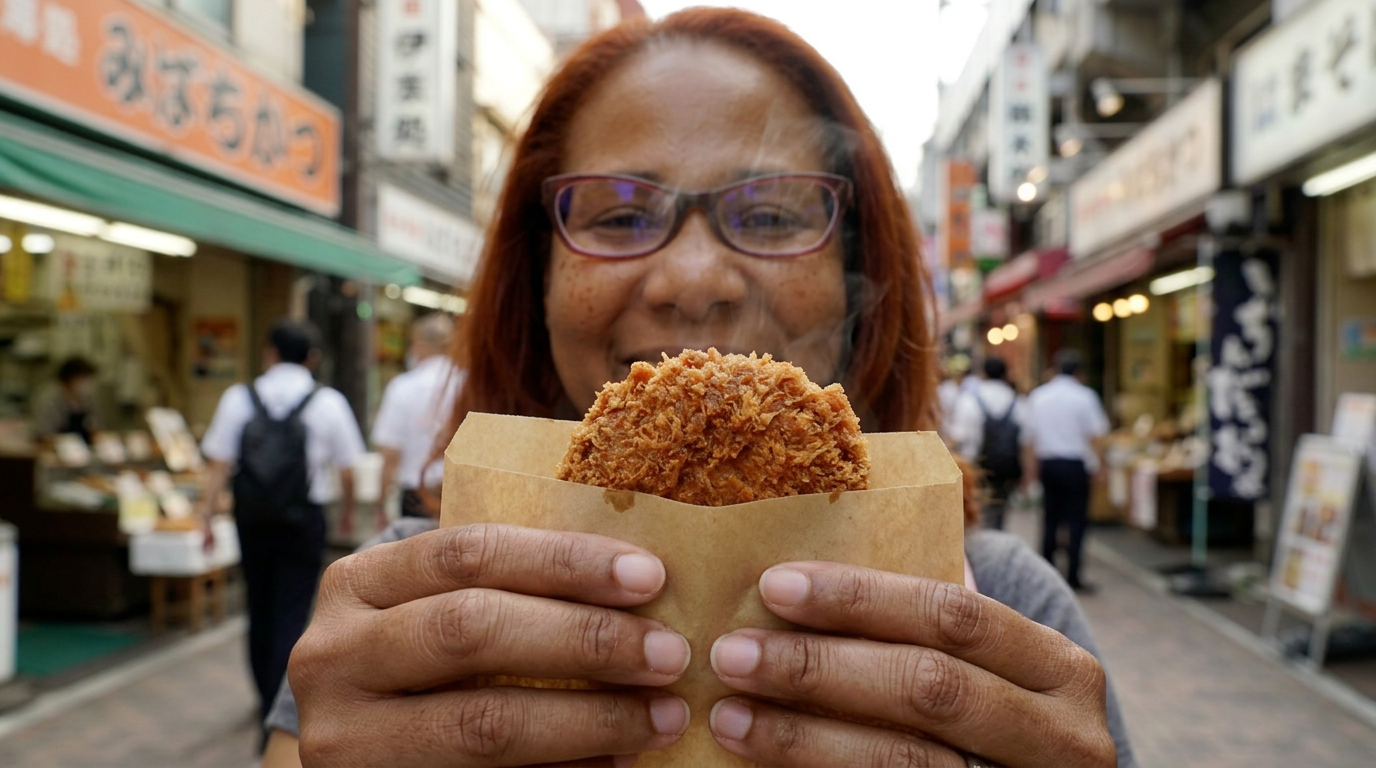
By 10:30 AM, my stomach was growling, so I headed toward Yanaka Ginza, the neighborhood's famous shopping street. It's a short, pedestrian-only strip that looks like a postcard from the 1950s. The scent of sweet soy glaze and frying oil was thick in the air. I stopped at a tiny wooden stall with a queue of three local grandmothers. They were selling 'menchi katsu'—a deep-fried minced beef and onion croquette. It cost me 250 Yen, which is less than two American dollars. I took a bite right there on the street, which is technically a minor social misstep in Japan—you are supposed to eat standing near the shop, not while walking. The exterior was so hot and crunchy it shattered, releasing this incredibly savory, onion-rich juice. It was simple, perfect comfort food, and worth every single crumb on my jacket.
After eating, I stumbled upon a tiny, exquisite shop called Shin-Yosha that specialized in hand-dyed chiyogami paper. The shopkeeper, a middle-aged woman wearing a beautiful linen apron, watched patiently as I ran my fingers over the textured, colorful sheets. I wanted to buy everything, but I settled on a small notebook bound in deep indigo paper for 1,200 Yen. When I handed her the cash, she didn't just drop it in a register; she placed it on a small tray, bowed deeply, and spent a full three minutes wrapping my tiny notebook in tissue paper and tying it with a piece of red hemp string. It felt like receiving a priceless gift.
By 1:00 PM, I was desperate for a place to sit. That is when I found Himitsudo, a legendary shaved ice shop hidden down a side alley. Usually, the line here is hours long, but because it was a chilly Tuesday afternoon, I got a seat at the counter in ten minutes. I ordered the seasonal strawberry and condensed milk 'kakigori' for 1,400 Yen. When they slid it across the counter, it looked like a mountain. The ice is hand-shaved from natural blocks of ice from Nikko, and it has the texture of fresh-fallen snow—it doesn't crunch, it just melts instantly on your tongue. They pour a thick, tart, handmade strawberry purée over the top that tasted like pure summer. My head was freezing, my hands were cold, but I couldn't stop eating.
For the late afternoon, I wanted to find a quiet corner to write in my new notebook. I walked up a steep hill to Tennoji Temple, which was founded in 1274. In the courtyard sits a massive bronze Buddha, cast in 1690, sitting peacefully under the sky. I sat on a wooden bench nearby for an hour, watching the shadows lengthen across the gravel garden. A young mother came by with her toddler, teaching him how to bow and clap twice at the shrine. It was a beautiful, intimate slice of everyday life that you completely miss when you are rushing from one major tourist sight to another.
As dusk began to settle, the neighborhood shifted. The lanterns along Yanaka Ginza flickered to life, casting a warm, amber glow on the wooden shopfronts. I was ready for a drink, but finding wine in a traditional neighborhood like this can be a challenge. Luckily, I had spotted a tiny sign earlier for a place called Cibi. It is a gorgeously restored warehouse that functions as a cafe by day and a cozy neighborhood spot by night. They had a small, incredibly curated selection of natural wines.
I sat at the wooden counter and ordered a glass of Orange Wine made from the Delaware grape, grown and produced in Yamanashi prefecture, which is Japan's main wine-producing region near Mount Fuji. It cost about 1,100 Yen. I'd never had Japanese wine before, and I was blown away. It was unfiltered, a cloudy amber color, smelling intensely of dried apricots and orange peel, but on the palate, it was bone dry, super crisp, and had this amazing mineral finish that tasted like wet stones. The young bartender spoke excellent English and told me all about how natural winemaking is exploding among younger Japanese growers. We chatted about the local neighborhood cats for twenty minutes while I sipped my wine.
For dinner, I wanted something comforting and local. I found a tiny, six-seat udon shop called Kamachiku, housed in a stunningly restored brick storehouse built in 1910. There is no English sign, just a heavy sliding wooden door. The room was warm, smelling of dashi broth and roasted sesame. The hospitality was incredibly gentle; they helped me tuck my bag under the counter and brought me a hot towel. I ordered the 'Kamaage Udon' for 1,000 Yen. It arrives as a huge wooden bowl of steaming water filled with thick, hand-stretched noodles, served with a side of concentrated, hot dashi dipping sauce, fresh ginger, scallions, and tempura flakes.
The technique is simple but takes a second to master: you mix your seasonings into the dipping sauce, lift a few strands of noodles from the hot water, dip them, and slurp. The texture of the noodles was unbelievable—chewy, bouncy, and carrying just enough of that rich, smoky fish broth with every bite. It was loud, satisfying, and deeply warming. I ate in near silence, surrounded by local salarymen who were slurping twice as fast and twice as loud as me.
A montage of warm, golden hour shots in Yanaka. The camera captures details: the steam rising from the udon bowl, the orange wine glistening in the glass, hand-painted signs of cats, the textures of old wooden doors, and Tara walking down quiet alleyways.
By 9:00 PM, the streets of Yanaka were almost entirely dark and empty, save for the occasional bicycle hum or the soft glow of a vending machine on a street corner. I walked back toward my hotel, feeling a sense of calm that I never thought I would find in a city of thirty-seven million people. If I had spent today chasing a ten-point itinerary across Tokyo, I would have spent half my time underground on subway platforms, stressed about train transfers, and looking at the city through a glass screen.
Instead, I spent the day looking at the moss growing on temple walls, watching an old man sweep his stoop, and learning that Japanese orange wine is absolutely incredible. I realized that you do not need to see everything to experience a place. Sometimes, by shrinking your world down to just one square mile, you actually make room to see the details that make a city beautiful.
If you are planning a trip to Tokyo, my biggest piece of advice is to give yourself permission to do absolutely nothing for one day. Pick a neighborhood, put your phone in your pocket, and just start walking. Let yourself get lost. Buy the cheap street food, sit on a temple bench, and listen to the crows. Because those are the moments you will actually remember when you go home.
Tara stands at the top of the 'Yuyake Dandan' steps, looking down at the quiet street below. She looks directly at the camera, smiles, and waves a gentle goodbye as the camera slowly pulls back, showing the peaceful residential street fading into the night.
Shot List
| Type | Description | Audio | Duration |
|---|---|---|---|
| Wide | Establishment shot of Yanaka's quiet residential street at sunrise. No people, just soft light hitting wooden houses. | Ambient sound of a distant temple bell and quiet wind. | 5s |
| Medium | Tara talking directly to the camera, standing in a denim jacket on a narrow street, looking excited. | Everyone tells you to cross the Shibuya Scramble, but today, I'm doing the exact opposite. | 8s |
| B-roll | Point-of-view walking shot through Yanaka Cemetery, cherry blossom leaves on the ground, stone lanterns. | Soft, relaxing acoustic guitar music starts. | 6s |
| Detail | Close-up of an elderly man gently sweeping a grave with a small hand brush, looking up and smiling. | Ambient sweeping sounds, birds chirping. | 5s |
| Medium | Tara standing in front of a street stall on Yanaka Ginza, receiving a piping hot croquette in brown paper. | It cost me 250 Yen, which is less than two American dollars. | 7s |
| Close-up | Extreme close-up of Tara taking a bite of the croquette. You can hear the loud crunch of the batter. | Crunch sound. Oh my gosh, that is so crispy and savory. | 5s |
| B-roll | Inside the Shin-Yosha paper shop, hands gently flipping through colorful, textured sheets of chiyogami paper. | Music swells slightly, very peaceful and traditional. | 6s |
| Detail | The shopkeeper's hands carefully wrapping a small notebook in tissue paper and tying a red string bow. | Paper rustling sounds. It felt like receiving a priceless gift. | 6s |
| Overhead | Overhead shot of a massive strawberry kakigori shaved ice bowl on a wooden counter, strawberry sauce dripping down. | Wow, look at the size of this thing! | 5s |
| Medium | Tara sitting on a wooden bench at Tennoji Temple, writing in her new paper notebook, looking relaxed. | I sat on a wooden bench nearby for an hour, watching the shadows lengthen. | 8s |
| Detail | A glass of cloudy orange wine being poured at the wooden counter of Cibi cafe, golden hour light hitting the glass. | I've never had Japanese wine before, and I was blown away. | 6s |
| Close-up | Close-up of steaming udon noodles being lifted from a wooden bowl with chopsticks and dipped into dashi sauce. | Loud slurping sounds. The texture of the noodles was unbelievable. | 6s |
| Medium | Tara walking down Yanaka Ginza street at night under warm glowing lanterns. The street is very quiet. | I realized that you do not need to see everything to experience a place. | 8s |
| Wide | Slow camera pull-back of Tara standing at the top of the Yuyake Dandan steps, waving as the neighborhood lights glow behind her. | Music fades out slowly with a soft guitar resolve. | 10s |
- Capture plenty of close-up hand movements: shopkeepers wrapping items, pouring wine, preparing food, and sweeping.
- Focus on the textures of Yanaka: weathered wood, stone lanterns, handmade paper, and the steam rising from food.
- Record high-quality ambient audio: temple bells, wind chimes, bicycle bells, paper rustling, and food sizzling.
- Keep the camera at eye level and use natural light as much as possible to maintain a cozy, authentic diary feel.
- 0:00 — Soft, minimalist acoustic guitar intro, setting a quiet and curious tone.
- 1:15 — Transition to a gentle, lofi warm beat as Tara walks through the cemetery.
- 2:45 — Upbeat, playful acoustic tune during the food tasting at Yanaka Ginza.
- 5:30 — Slow, meditative ambient synth pad while Tara sits at the quiet temple.
- 7:15 — Warm, jazzy instrumental lounge music as evening falls and she enters the wine bar.
- 9:00 — Soft, reflective acoustic guitar melody returns for the final payoff and wrap-up.
- Keep transitions simple and natural—mostly clean cuts. Avoid flashy digital wipes or transitions.
- Enhance the natural environmental sounds (slurping, sweeping, paper rustling) in the audio mix to make it immersive.
- Use a warm, slightly vintage color grade to match the retro, nostalgic 'shitamachi' feel of Yanaka.
- Keep text overlays minimal and clean. Use a simple, elegant sans-serif font for location names and prices.
| Call | Provider | Model | Input Tokens | Output Tokens | Compute / Credits |
|---|---|---|---|---|---|
| Script | abacus.ai | gemini-3.5-flash | 1,559 | 4,539 | — |
| Image 1 — The Quiet Street | abacus.ai | nano_banana2 | — | — | 6,788.2 |
| Image 2 — The First Bite | abacus.ai | nano_banana2 | — | — | 6,787.9 |
| Image 3 — The Sunset Steps | abacus.ai | nano_banana2 | — | — | 6,787.75 |
I avoided Bangkok's traffic for a day. It changed everything.
I spent a day navigating Bangkok entirely by canals and rivers, finding a quiet, watery world hidden right behind the gridlock.
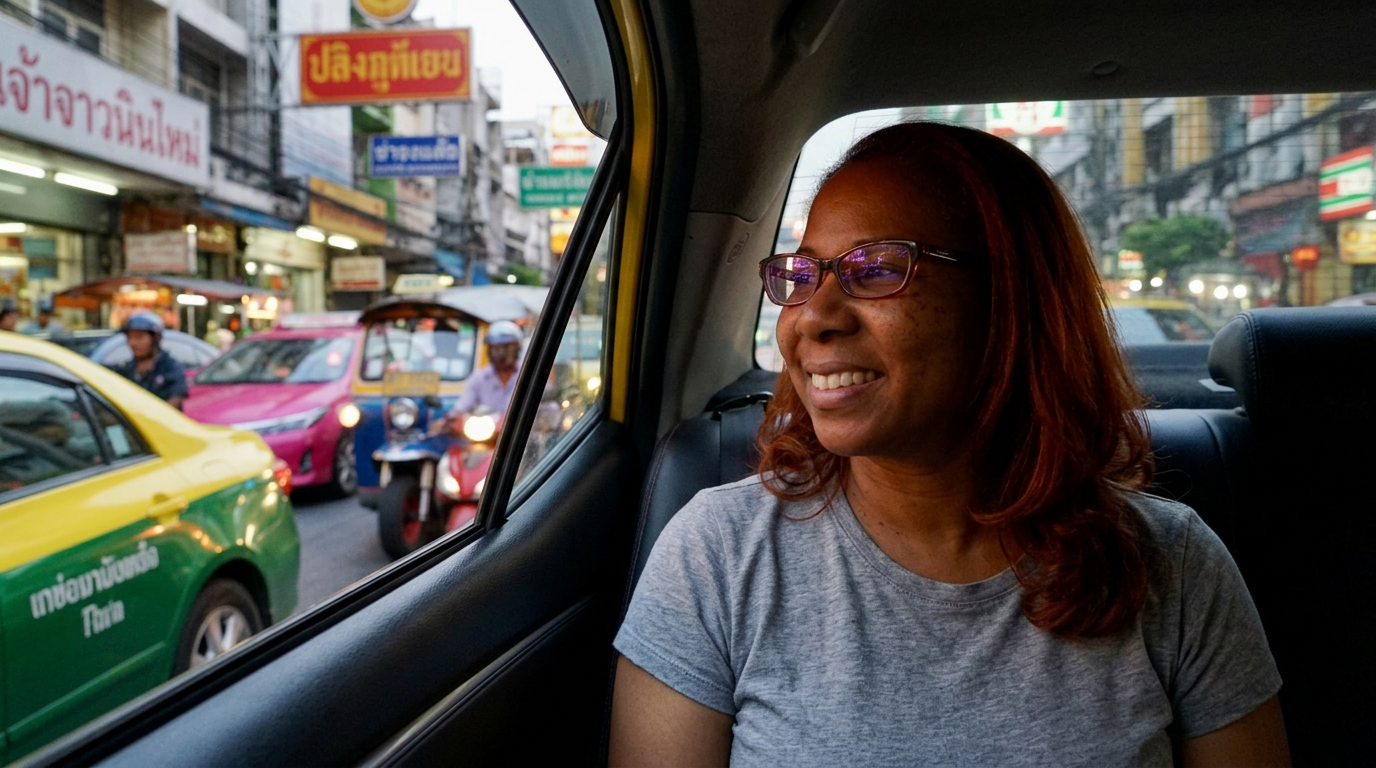
They told me Bangkok has some of the worst traffic in the world, and after an hour of staring at a stationary taxi bumper, I believed them. So today, Tony and I are throwing away the road map and navigating this massive city entirely by water.
Handheld shot of Tara looking out a taxi window at a sea of red brake lights in the humid heat, then transitioning to a sudden splash of river water against wood.
We had been in Bangkok for exactly twenty-four hours, and to be honest, I was feeling incredibly overwhelmed. The noise of the scooters, the humidity that hits you like a warm, wet blanket the second you step outside, and the sheer scale of the concrete lanes had me feeling totally out of my depth. Our home base in Orlando is flat and car-centric, but this was a whole different beast. Tony and I were staying in a small guesthouse near Khao San Road, but we wanted to see the real, historic heart of the city without spending our entire budget—and our sanity—sitting in suffocating traffic jams.
That is when a lovely woman at our guesthouse reception desk, named Pim, saw me staring blankly at a transit map and took pity on us. She drew a blue line right through the center of the chaos and told us to find the Saen Saep canal boat. She promised it would cost less than a bottle of water and would show us a side of Bangkok most tourists zoom right past in their air-conditioned grabs.
I was incredibly nervous. I had read about the canal boats; they are notorious for being fast, crowded, and not particularly forgiving if you miss your step. I pictured myself slipping into the murky canal water with my camera gear, causing a massive scene. We packed light—just my small backpack, a bottle of water, and our worn-out map—and set off on foot toward the Phan Fa Lilat bridge to find our first pier.
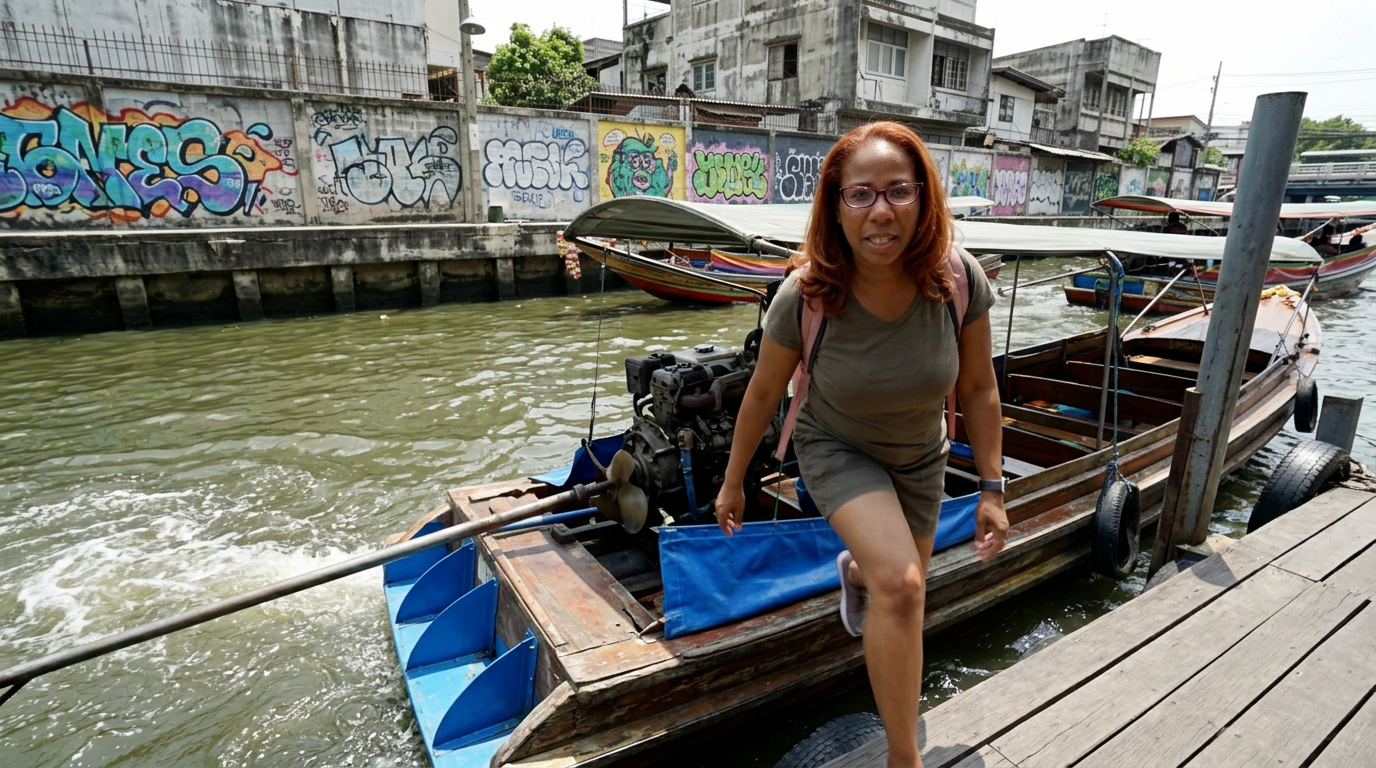
The heat at 9:30 AM was already pressing down on us as we walked down the concrete steps to the canal. The water of the Khlong Saen Saep was dark, and the canal walls were covered in brilliant, colorful street art. When the long, low wooden boat roared up to the wooden dock, it did not actually stop. It hovered against the tires lining the concrete wall while passengers leaped on and off with practiced agility. My heart was lodged firmly in my throat. Tony went first, grabbing my hand as I made the awkward, giant step over the gap, my linen trousers dragging slightly on the wet deck. We paid the conductor—a man balancing effortlessly on the outside ledge of the boat, wearing a helmet—just 12 Thai Baht each, which is about thirty-five cents.
As the boat accelerated, splash guards made of blue plastic tarps were pulled up by the passengers using a system of ropes to keep the canal water from flying into our faces. The breeze was instant and glorious. For thirty minutes, we zoomed past the backs of wooden houses, hidden temples, and laundry lines draped over balconies, completely bypassing the gridlock on the roads above us. We hopped off at the Pratunam pier, feeling an incredible rush of accomplishment. We had actually done it, and we were completely dry.
From Pratunam, we walked through the towering, glossy shopping districts to find a contrast to the old canals: the peaceful, green expanse of Lumphini Park. We paid nothing to enter and spent an hour walking along the paved paths under the shade of massive rain trees. The highlight was spotting several enormous water monitors—massive lizards that look like modern-day dinosaurs—swimming lazily in the central lake. Locals were doing tai chi, and for a moment, the roar of Bangkok felt miles away.
By lunchtime, we were starving, so we navigated our way toward a small, legendary spot near the Sam Yan district called Som Tum Jatorat. The room was loud, cooled only by wall-mounted fans, and packed with university students. We ordered the classic Som Tum (spicy green papaya salad) with salted egg, and a plate of crispy fried chicken wings. The papaya salad was a vibrant, fiery red that immediately made my eyes water, but the balance of lime, palm sugar, and fish sauce was absolutely perfect. It cost us 180 Baht (around five dollars) for a feast that left our lips tingling and our bellies incredibly happy.
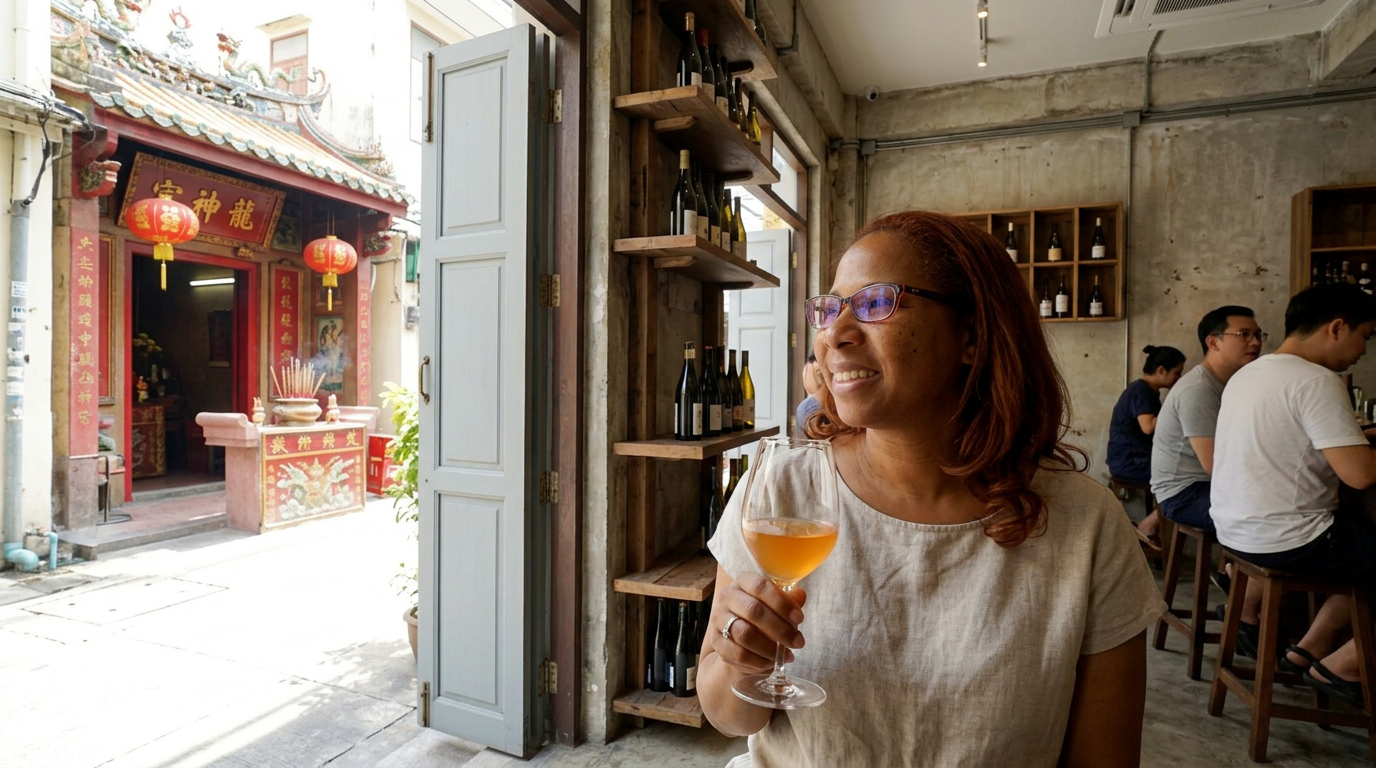
To cool down after that spicy lunch, we decided to seek out Bangkok's surprising natural wine scene. We took a blue MRT subway train down to the Chinatown area and walked down a narrow, quiet alleyway in the historic Talat Noi neighborhood to find a tiny, beautifully restored shophouse called Mod Kaew Wine Bar. It was cozy, cool, and felt like a secret clubhouse.
We struck up a conversation with the bartender, who recommended a glass of a natural orange wine made from Chenin Blanc grapes grown in the Asoke Valley of Khao Yai, just a few hours north of Bangkok. I had no idea Thailand even produced wine! It was cloudy, tart, and tasted like fresh peaches and wild yeast—incredibly refreshing in the tropical heat. It was a bit of a splurge at 320 Baht (about nine dollars) a glass, but sitting in that quiet, air-conditioned sanctuary, sipping local Thai wine while looking out at the ancient Chinese shrine across the alley, was worth every single Satang.
As the sun began to dip, we walked down to the nearby Marine Department Pier on the Chao Phraya River. This time, we boarded the large, orange-flag public express boat for 16 Baht. Moving from the narrow, intimate canals to the wide, majestic river was breathtaking. The golden light of the late afternoon hit the glittering spires of Wat Arun—the Temple of Dawn—across the water. The river was alive with orange barges, longtail boats kicking up spray, and massive commuter ferries.
We hopped off at the Tha Tien pier, right across from Wat Arun. Instead of fighting the crowds inside the temple grounds, we walked into a quiet side street and found a tiny, unassuming rooftop bar overlooking the river just as the sky turned a deep, bruised purple. We watched the temple light up, its porcelain tiles glowing gold against the night sky, feeling the cool river breeze wash over us.
B-roll of the splashing canal water, passenger hands pulling up the blue tarps, the giant water monitors in Lumphini Park, close-ups of the fiery papaya salad, the pouring of cloudy orange wine, and the golden lights of Wat Arun glittering on the river surface.
As we sat by the river, watching the ferry boats carry commuters home under the glowing silhouette of Wat Arun, I realized how much my perspective of Bangkok had shifted. This city is not just a concrete jungle of traffic jams and exhaust fumes. It is a living, breathing water highway that has survived for centuries beneath the modern skyline.
By choosing the boats over the roads, we did more than just save a few Baht and escape the traffic. We found the rhythm of the city. We saw the back porches where grandmothers feed pigeons, the hidden shrines tucked under concrete bridges, and the quiet spaces where Bangkok takes a breath.
If you are coming to Bangkok, my biggest piece of advice is to step off the curb and get onto the water. Don't be afraid of the speed of the canal boats or the splash of the canal. Embrace the chaos, hold on tight, and let the river show you the heart of this incredible place.
Slow zoom out from Tara and Tony sitting at the riverside table, clinking their glasses together as the illuminated temple glows brilliantly in the background dusk.
Shot List
| Type | Description | Audio | Duration |
|---|---|---|---|
| Wide | Establishment shot of Bangkok's heavy traffic on a bridge, shimmering in the heat haze. | Ambient sound of honking horns and roaring scooter engines. | 5s |
| Medium | Tara talking directly to the camera on a busy sidewalk, looking slightly sweaty and holding a map. | So we are abandoning the taxis today. We are going down there, to the water, to see if we can survive the canals. | 8s |
| B-roll | The wooden canal boat roaring up to the concrete pier, water churning behind it. | Loud, throaty diesel engine roar of the canal boat. | 4s |
| Close-up | Tara's feet making the big step from the damp wooden dock onto the moving boat deck. | Screech of rubber tires against the concrete wall. | 3s |
| Detail | A passenger's hand pulling up the blue plastic splash guard rope as the boat accelerates. | Whip of wind and the sound of rushing water. | 4s |
| Medium | Handheld shot of Tony smiling, wind in his hair, looking out at the passing canal-side wooden homes. | Tara: Look at this! No cars, just breeze. | 6s |
| Wide | A massive water monitor lizard swimming slowly across the green lake in Lumphini Park. | Soft chirping of birds and distant city hum. | 5s |
| Overhead | A table shot of the vibrant green papaya salad with salted egg and crispy fried chicken wings. | Sizzle of the busy restaurant and clatter of plates. | 4s |
| Close-up | Tara taking a bite of the papaya salad, her eyes widening from the spice as she reaches for water. | Tara: Oh wow, that is instant heat. But it is so, so good. | 7s |
| B-roll | Walking shot down the narrow, historic alleyways of Talat Noi, passing old engine parts and street art. | Distant chatter and the low hum of an air conditioner. | 5s |
| Detail | Cloudy orange wine being poured from a minimalist bottle into a wine glass at Mod Kaew Wine Bar. | Glug of wine pouring into the glass. | 4s |
| Medium | Tara sitting at the bar counter, tasting the wine and looking thoughtfully at the glass. | Tara: It's like a sour peach cider, but incredibly clean. Perfect for this humidity. | 8s |
| Timelapse | The sun setting behind the spires of Wat Arun across the Chao Phraya River, boats crossing back and forth. | Fades into soft, warm acoustic travel music. | 10s |
| Medium | Tara and Tony sitting at a small wooden table by the river, clinking glasses as the temple lights turn on. | Tara: To getting lost, and finding the right way anyway. | 6s |
- Capture plenty of close-up hand movements on the canal boats, like passengers grabbing the guide ropes and conductors collecting coins.
- Get wide shots of the water monitors in Lumphini Park to contrast with the high-speed transit footage.
- Focus on the steam and sizzle of the street-side kitchen when filming at the papaya salad restaurant.
- Do a slow panning shot of the wine bottle label to clearly show the Thai origin of the Chenin Blanc.
- 0:00 — Loud, chaotic street sounds fading quickly into a low, tense synthetic beat during the traffic scene.
- 0:45 — Upbeat, energetic acoustic guitar track starts as they head down to the canal dock.
- 1:30 — Percussive, fast-paced rhythm matching the engine roar of the canal boat ride.
- 3:15 — Soft, airy, atmospheric lo-fi track playing during the peaceful Lumphini Park walk.
- 5:00 — Playful, bouncy instrumental music as they sit down for the spicy lunch challenge.
- 6:45 — Cool, jazz-infused indie chords as they enter the air-conditioned Mod Kaew wine bar.
- 8:30 — Warm, swelling acoustic guitar and strings as the river boat glides past Wat Arun at sunset.
- Use quick, snappy cuts during the canal boat boarding sequence to emphasize the speed and slight chaos of the moment.
- Keep the natural ambient sounds of the boat engines and street vendors high in the mix to make the viewer feel the texture of Bangkok.
- Add a subtle, clean lower-third graphic showing the currency conversion whenever prices are mentioned (e.g., '12 THB / $0.35 USD').
- Slow down the pacing significantly during the wine bar and sunset scenes to mirror the emotional transition from frantic travel to relaxed appreciation.
| Call | Provider | Model | Input Tokens | Output Tokens | Compute / Credits |
|---|---|---|---|---|---|
| Script | abacus.ai | gemini-3.5-flash | 1,559 | 3,962 | — |
| Image 1 — The Gridlock Escape | abacus.ai | nano_banana2 | — | — | 6,788.35 |
| Image 2 — The Canal Jump | abacus.ai | nano_banana2 | — | — | 6,788.05 |
| Image 3 — A Secret Toast in Talat Noi | abacus.ai | nano_banana2 | — | — | 6,788.55 |
I Got Lost in Lisbon (And Let a €4 Glass of Wine Slow Me Down)
I chased the light through the steepest hills of Lisbon and let a crisp glass of Vinho Verde completely change how I travel.
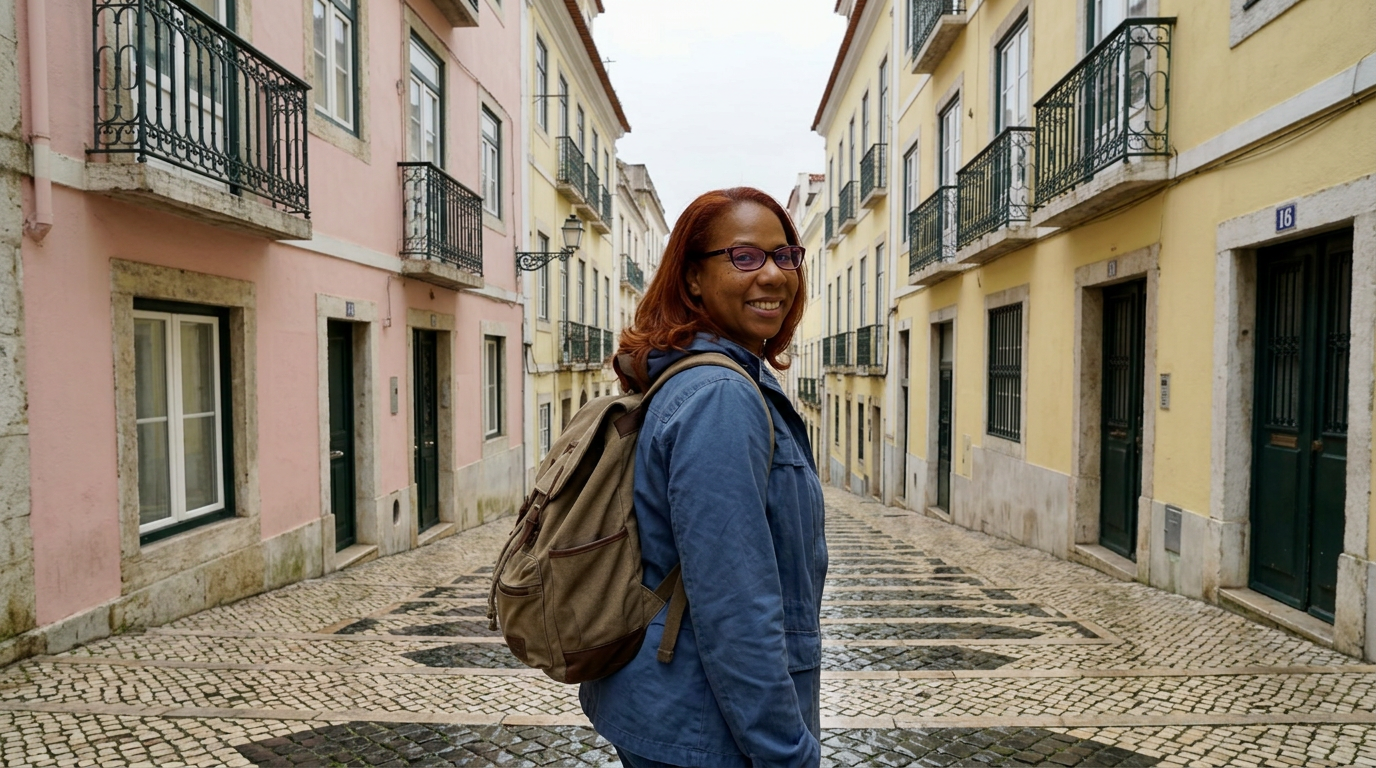
They call Lisbon the city of seven hills, but what they don't tell you is that every single one of them is paved with slick, polished cobblestones designed to test your gravity. I came here with a packed itinerary, but a wrong turn and a very steep climb forced me to throw the whole plan away.
Handheld shot of Tara laughing, slightly out of breath, leaning against a pastel pink wall in Alfama. She's wearing a cream linen shirt, a canvas backpack, and sensible sneakers. The camera tilts down to show her slipping slightly on the glossy cobblestones, then pans up to a yellow tram rattling past in the background.
I landed in Lisbon at 8:00 AM on a crisp Tuesday morning in October. The flight from Orlando was long, and by the time Tony and I hauled our carry-ons through the Metro system to our small guesthouse in the Chiado neighborhood, my brain was running on pure adrenaline and espresso. I had this entire day mapped out on my phone. We were going to hit three different viewpoints, tour the ruins of the Carmo Convent, grab pastel de nata at the famous spot, and take a sunset cruise on the Tagus River. It was a perfect, highly efficient, completely exhausting plan.
But Lisbon has a way of laughing at your plans. Our room wasn't ready yet, so we left our bags with the receptionist, who smiled warmly and told us to 'just walk up.' Up. That is the defining word of this city. We stepped out of the lobby and were immediately confronted with a street that looked less like a road and more like a paved staircase. My legs were already heavy from the transatlantic flight, and my camera bag was digging into my shoulder.
As we started walking up towards the Baixa district, the sheer scale of the city hit me. The buildings are covered in these incredibly intricate, glazed ceramic tiles called azulejos, reflecting the bright Atlantic sun. The air smelled like roasting coffee, salty sea breeze, and old stone. I felt that familiar, nervous travel energy bubbling up—the pressure to see everything immediately, to capture the perfect shot, to prove we were having the 'best time.'
Tony suggested we get a coffee first to clear our heads, but I was determined to reach the Miradouro de São Pedro de Alcântara before the midday crowds arrived. I was so focused on my digital map that I didn't notice the sky turning a heavy, metallic grey. By the time we reached the viewpoint, the beautiful, sunny postcard view of the castle was completely swallowed by a sudden, driving Atlantic downpour. My phone battery was at twelve percent, my hair was plastered to my forehead, and my perfect itinerary was officially ruined.
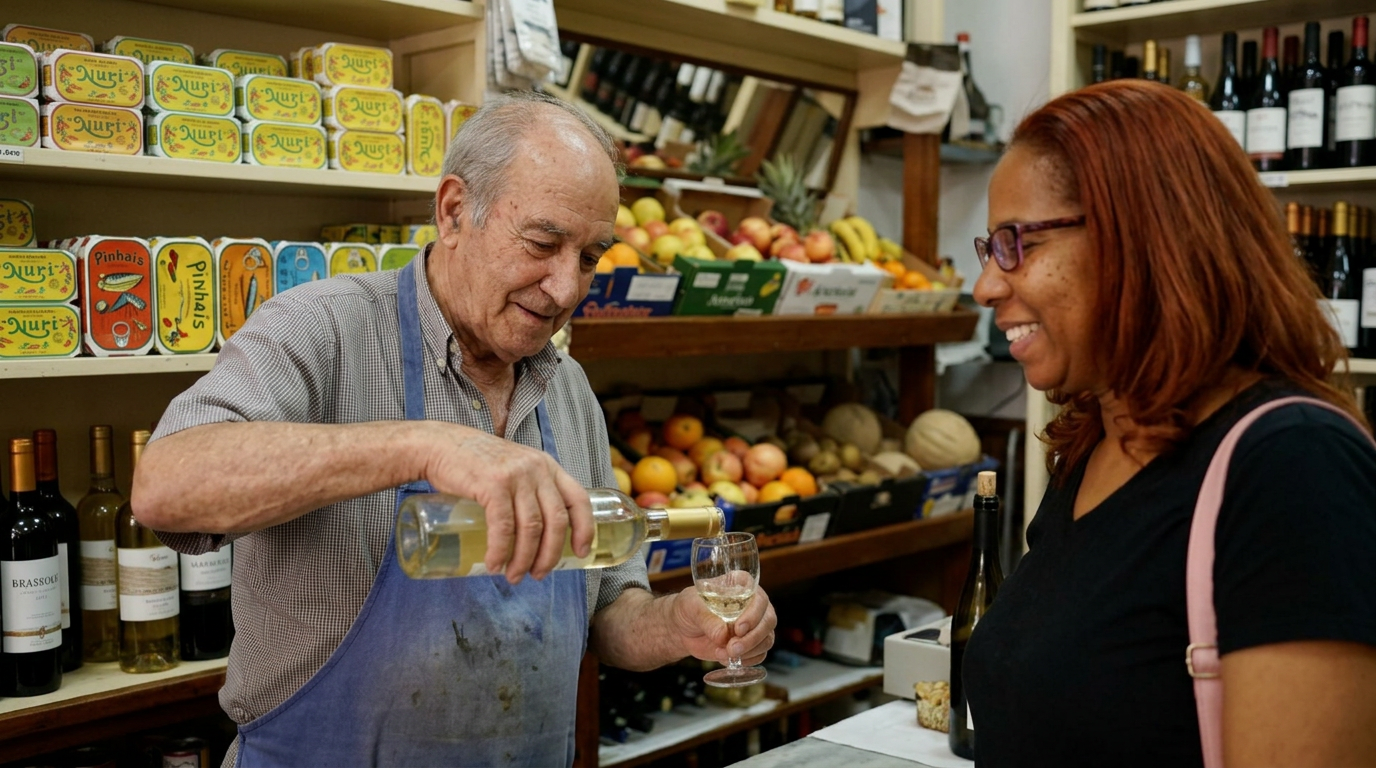
We huddled under the narrow canvas awning of a tiny, unnamed corner grocery store, watching the rain bounce off the black-and-white stone mosaics of the sidewalk. I was frustrated. I had spent weeks planning this day, and now we were stuck, shivering in a doorway. But then, the shopkeeper—an elderly man with a kind, lined face and a faded blue apron—stepped outside. He didn't speak English, and my Portuguese is non-existent, but he looked at my dripping hair, chuckled softly, and pointed to two plastic stools inside his shop.
He disappeared behind a counter piled high with salted cod and canned sardines, and returned not with espresso, but with two small, chilled glasses and a golden bottle of Vinho Verde. He poured them to the brim, smiled, and said, 'Bebe.' Drink. It was a local Loureiro blend from the Minho region up north. It cost exactly two Euros per glass. It was slightly effervescent, crisp, and tasted like green apples and sea salt. It was the most refreshing thing I have ever tasted.
Sitting on those plastic stools, surrounded by boxes of Portuguese pears and hanging cured meats, the tension in my shoulders finally dropped. The rain was drumming loudly on the tin roof, but inside, it was warm and quiet. Tony looked at me and said, 'Well, the view isn't going anywhere.' He was right. Why was I rushing? We sat there for forty-five minutes, sipping our wine and watching the locals run past with newspapers over their heads. That four-Euro moment did what a night of sleep couldn't: it finally brought me to Lisbon.
When the rain finally cleared, leaving the streets glistening like melted sugar, we decided to ditch the map entirely. We wandered into the Alfama district, the oldest neighborhood in the city. It’s a labyrinth of narrow alleys, tiny archways, and steep staircases where residents hang their laundry out of shuttered windows directly over your head. We followed the faint smell of woodsmoke and the distant, melancholic sound of a Fado singer practicing inside a closed tavern.
It was past 2:00 PM when our stomachs started growling. We stumbled upon a tiny, bustling spot called 'A Tendinha' near Rossio Square. It was loud, packed with locals leaning against a marble counter, and smelled intensely of garlic and fried seafood. There were no tourists in sight, which is always a good sign, even if it makes ordering a bit of a gamble.
We squeezed into a corner table and ordered what everyone else was eating: Bifanas—simple pork sandwiches marinated in white wine, garlic, and lard, served on crusty rolls with plenty of yellow mustard—and a plate of sizzling Ameijoas à Bulhão Pato (clams cooked with olive oil, garlic, coriander, and white wine). The entire lunch, including two cold beers, cost us eighteen Euros. The pork was incredibly tender, savory, and messy, and we used the bread to soak up every single drop of the garlic-clam broth. It was simple, unpretentious, and absolutely perfect.
With full bellies and dry clothes, we spent the afternoon just walking. We bypassed the famous Tram 28, which was packed to the gills with tourists, and instead took the historic Elevador da Glória—a funicular railway built in 1885 that grinds its way up one of the steepest hills in the city. The ticket was four Euros, and the ride was bumpy, loud, and felt like a journey back in time.
At the top, we found ourselves in the Principe Real neighborhood, which has a completely different vibe—quieter, with leafy plazas, indie boutiques, and grand nineteenth-century mansions. We sat on a stone bench under a massive, hundred-year-old cedar tree that spreads out like a giant green umbrella, watching old men play cards in the shade. I realized that the best parts of Lisbon aren't the monuments you pay to enter; they are the spaces in between them.
As the afternoon light began to soften into that warm, golden hue that Lisbon is famous for, we made our way back down towards the riverfront. The city started to glow. The pastel pinks, yellows, and blues of the buildings seemed to soak up the sunset, radiating a warm, comforting light that felt almost magical.
B-roll of the rain stopping, streets reflecting the yellow tram lines. Close-ups of the Vinho Verde being poured, the condensation on the glass. Handheld walking shots through the extremely narrow, colorful alleys of Alfama. Quick cuts of the noisy lunch spot, the steam rising from the clams, and the funicular climbing the steep hill.
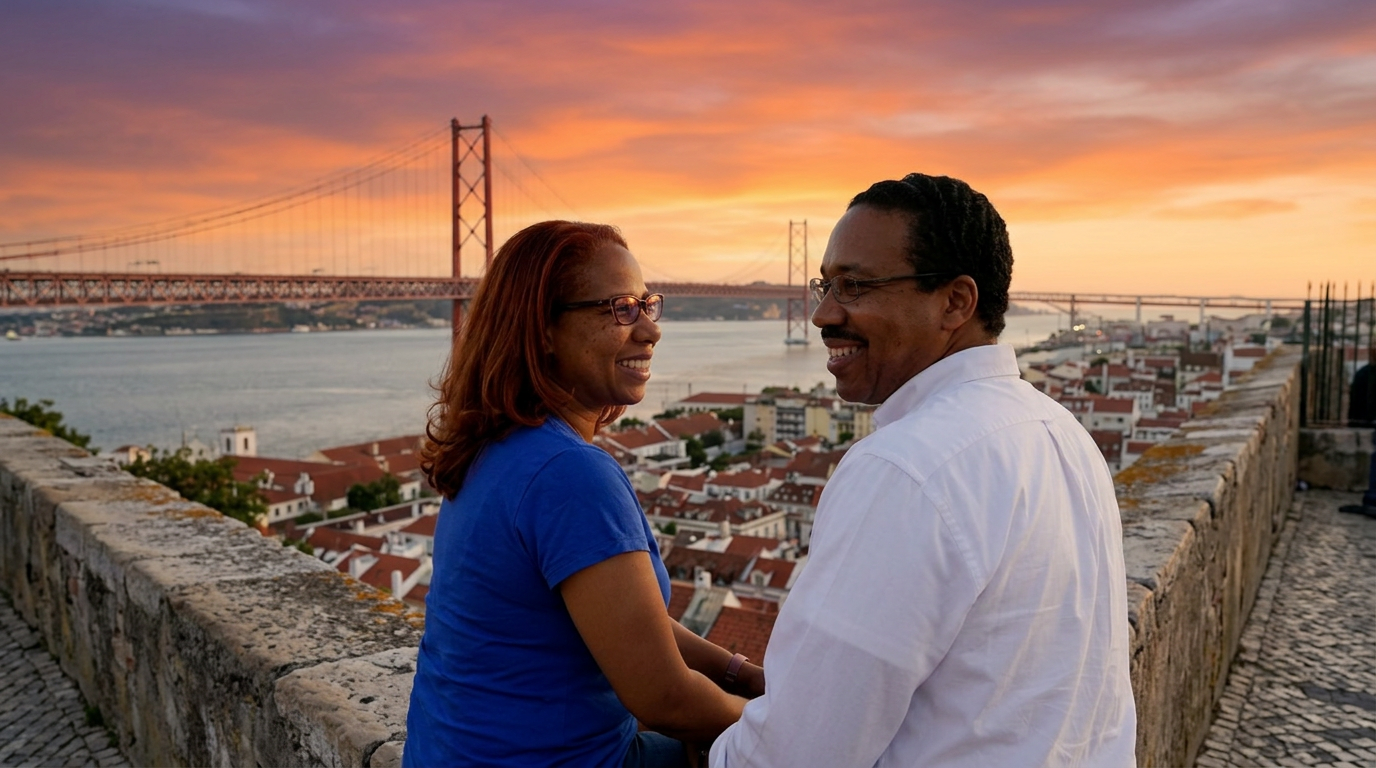
We ended our day at the Miradouro da Senhora do Monte, the highest viewpoint in the city. The climb up was brutal, and my calves were burning, but when we reached the top, the entire city layout opened up below us. We could see the historic castle ruins on the opposite hill, the red suspension bridge spanning the Tagus River, and the orange rooftops stretching all the way to the Atlantic.
We bought a cold bottle of Vinho Verde from a small kiosk at the viewpoint for eight Euros, and sat on the low stone wall as the sun dipped below the horizon. The sky turned from orange to deep violet, and the streetlights began to flicker on across the hills like a scattering of diamonds. The wind was cool, but the city felt incredibly warm.
If you are planning a trip to Lisbon, my best advice is to wear shoes with good grip, buy an umbrella, and most importantly, leave room in your schedule to get lost. Don't let a rainstorm or a missed tram ruin your day. Sometimes, the best view in the city is the one you find when you stop looking at your map and start looking at what's right in front of you.
Slow, sweeping wide shot of the Lisbon skyline at dusk from the viewpoint. Camera pans to Tara and Tony sitting on the stone wall, clinking their glasses of Vinho Verde together, looking out over the glowing city. The camera slowly zooms out as the city lights twinkle.
Shot List
| Type | Description | Audio | Duration |
|---|---|---|---|
| Wide | Establishment shot of the Lisbon skyline under a dramatic, cloudy grey sky from a high viewpoint. | Ambient city sounds, distant tram bells, and wind. | 5s |
| Medium | Tara walking up a steep, narrow cobblestone street in Chiado, looking at her phone with a slightly stressed expression. | Tara (VO): 'I had this entire day mapped out... It was a perfect, highly efficient, completely exhausting plan.' | 7s |
| Close-up | Raindrops suddenly splashing heavily onto the patterned black-and-white cobblestone sidewalk. | Sudden, loud sound of a downpour hitting the pavement. | 4s |
| Medium | Tara and Tony huddled under a small canvas awning, wet hair, smiling sheepishly at the camera. | Tara: 'And then, the sky opened up. This is not the sunny postcard I was promised.' | 6s |
| Detail | An elderly Portuguese shopkeeper pouring pale golden, bubbly Vinho Verde into two small, simple glasses. | Sound of wine pouring, soft background murmur of a small shop. | 5s |
| Close-up | Tara taking a sip of the wine, her eyes widening in surprise, then smiling warmly at the camera. | Tara: 'Oh, wow. It's so crisp. It almost sparkles. And it's exactly two Euros.' | 8s |
| B-roll | Montage of the rain clearing, wet streets reflecting the colorful buildings, and a yellow tram passing by. | Upbeat, acoustic acoustic guitar music swells. | 10s |
| Medium | Tara walking through the extremely narrow, winding alleys of Alfama, looking up at laundry hanging from balconies. | Tara (VO): 'We decided to ditch the map entirely. We wandered into the Alfama district...' | 8s |
| Overhead | A steaming plate of garlic clams (Ameijoas à Bulhão Pato) and a rustic pork sandwich (Bifana) on a marble table. | Loud, energetic chatter of a busy Portuguese tavern. | 6s |
| Close-up | Tara tearing off a piece of bread, dipping it into the garlic broth, and taking a bite with an expression of pure joy. | Tara: 'This is the definition of simple comfort food. Garlic, wine, olive oil. Yes.' | 7s |
| B-roll | The historic Elevador da Glória funicular grinding its way slowly up a steep, graffiti-covered hill. | Rattling and mechanical clanging of the funicular railway. | 8s |
| Wide | Golden hour light hitting the pastel pink and yellow buildings of Lisbon, overlooking the Tagus River. | Tara (VO): 'As the afternoon light began to soften... the city started to glow.' | 6s |
| Medium | Tara and Tony sitting on a stone wall at Miradouro da Senhora do Monte, pouring wine from a bottle into plastic cups. | Soft, melodic Portuguese acoustic guitar music plays. | 8s |
| Timelapse | The sun setting over the Lisbon skyline, the sky shifting from orange to deep purple as the city lights turn on. | Tara (VO): 'Sometimes, the best view in the city is the one you find when you stop looking at your map...' | 10s |
| Close-up | Tara looking directly at the camera, smiling, with the twinkling lights of Lisbon blurred in the background. | Tara: 'Go get lost. I promise you'll find something beautiful. See you next adventure.' | 8s |
- Capture close-up details of the patterned cobblestones (calçada portuguesa), especially how they glisten when wet or catch the golden hour light.
- Film the yellow historic trams from a low angle as they rattle around tight corners in Alfama, letting them fill the frame and pass by.
- Get detail shots of the beautiful ceramic tiles (azulejos) on the exterior of buildings, showing the textures and cracks of age.
- Record the natural soundscape: tram bells, seagulls near the river, the hum of the funicular, and snippets of locals talking.
- 0:00 — Intense, dramatic cello music to match the grey skies and stressful travel opening.
- 1:15 — Sudden stop of music as the rain starts, relying only on natural rain sounds.
- 2:30 — Soft, warm, light acoustic guitar begins as the shopkeeper pours the wine.
- 4:15 — Upbeat, rhythmic Portuguese guitar swing as they walk through the sunny streets of Alfama.
- 6:00 — Lively, brassy, old-school jazz-tempo track during the chaotic and delicious tavern lunch.
- 8:20 — Slow, soulful, traditional Fado acoustic guitar melody as the golden hour sets in and they reach the highest viewpoint.
- Keep the transitions natural—avoid flashy digital wipes. Use match cuts (like cutting from a splash of rain on the ground to a splash of wine in the glass).
- Let the audio breathe. When the rain starts, lower the music entirely to let the ambient sound of the storm create a sensory experience.
- Use warm, golden-hour-inspired color grading that highlights the pastel pinks, yellows, and blues of the Lisbon architecture without oversaturating.
- Keep text overlays minimal. When displaying the 'City Card' at the end, use a clean, elegant, semi-transparent dark overlay to keep the beautiful sunset visible behind it.
| Call | Provider | Model | Input Tokens | Output Tokens | Compute / Credits |
|---|---|---|---|---|---|
| Script | abacus.ai | gemini-3.5-flash | 1,565 | 4,639 | — |
| Image 1 — The Slippery Climb | abacus.ai | nano_banana2 | — | — | 6,789.25 |
| Image 2 — The Shopkeeper's Gift | abacus.ai | nano_banana2 | — | — | 6,788.95 |
| Image 3 — The Golden Viewpoint | abacus.ai | nano_banana2 | — | — | 6,788.95 |
I Woke Up at 4:30 AM to Experience Kathmandu Before the Chaos
I wanted to see Kathmandu before the motorbikes, dust, and crowds took over, so I walked the ancient, silent alleyways of the old city at dawn and found a side of Nepal most travelers rush right past.
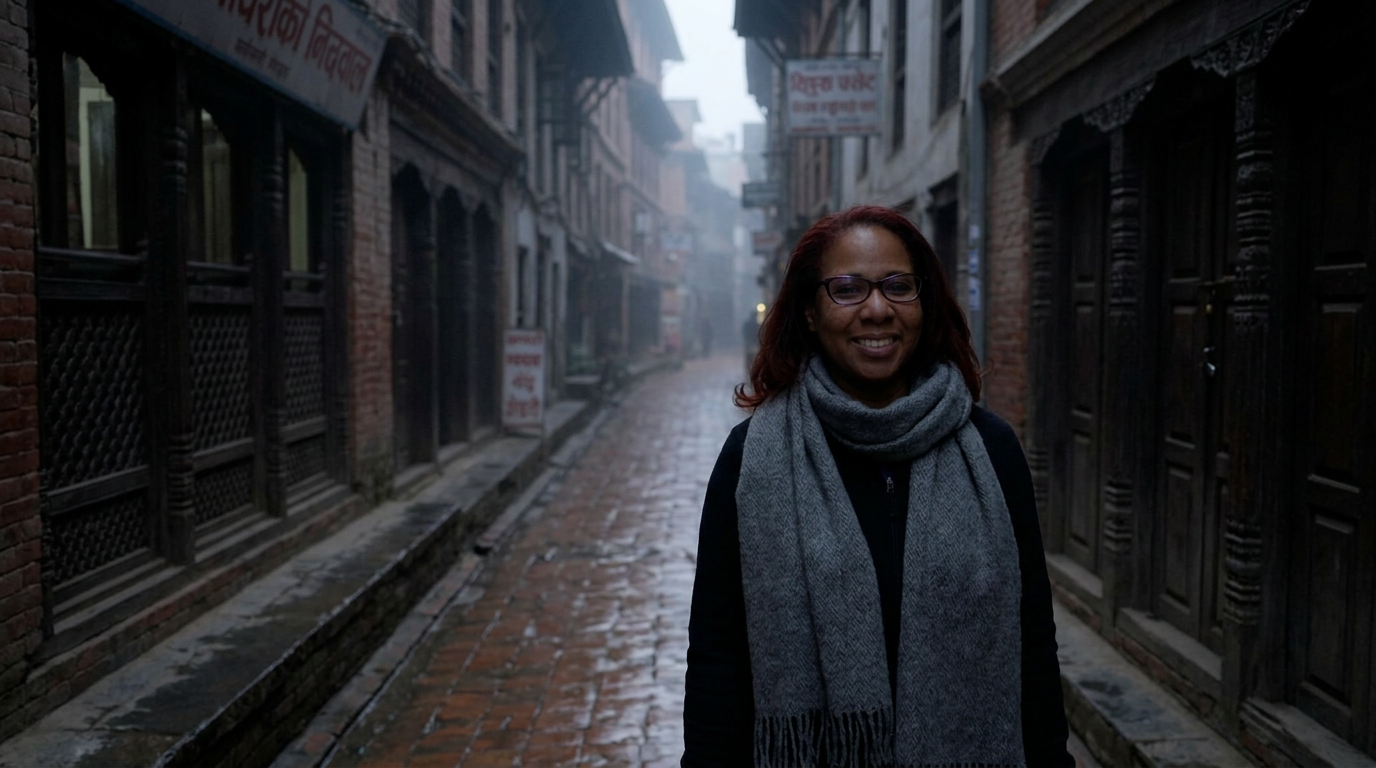
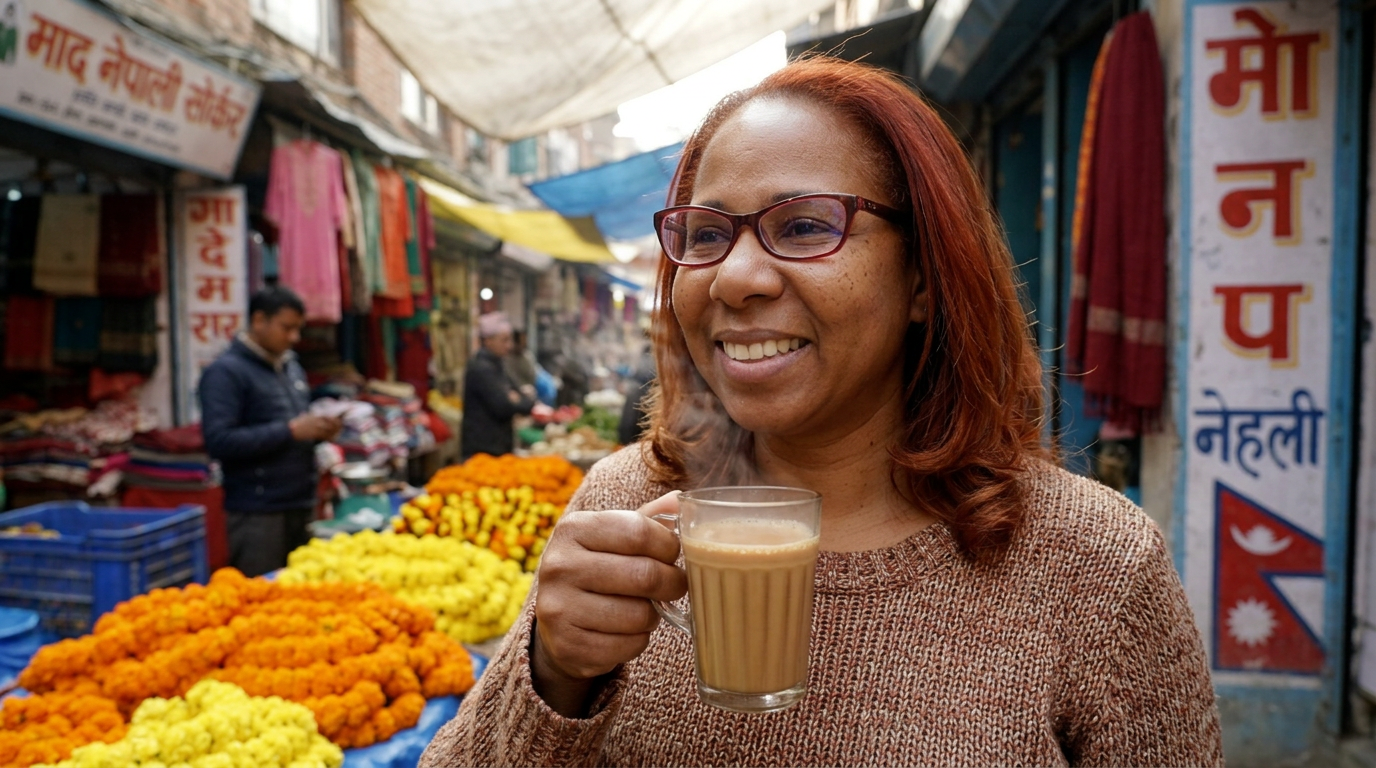
Everyone told me Kathmandu is a sensory assault of dust, honking horns, and pure chaos. But if you wake up before the sun, you find an ancient city of quiet stone temples, burning incense, and a magic that feels older than time itself.
Handheld, slightly shaky camera footage walking through a misty, dimly lit brick alleyway in Kathmandu. The only sound is the distant chime of a temple bell and Tara’s soft footsteps.
I have to be honest with you. When Tony and I first landed at Tribhuvan International Airport yesterday, my anxiety spiked. The air was thick with Kathmandu's infamous smog, the traffic was a gridlocked sea of honking microbuses, and my throat immediately started itching. We are staying in Thamel, the bustling tourist hub, which is packed with neon signs, trekking gear shops, and people selling everything from singing bowls to cashmere scarves. It was overwhelming, loud, and I felt completely out of my depth.
I sat in our room last night, listening to the street noise below, wondering how I was going to connect with this city. That is when our guesthouse host, a kind man named Pemba, gave me a piece of advice. He said, 'Tara, if you want to see the real Kathmandu, you have to see her sleep. Wake up before the motorbikes.' So, that is exactly what I decided to do. Tony decided to sleep in—he is not a morning person at the best of times, let alone at 4:30 AM on a chilly Himalayan morning—so I grabbed my camera, wrapped my favorite woolen scarf tight around my neck, and slipped out into the dark.
My plan was simple but slightly terrifying for me: walk from our hotel in Thamel down through the ancient, labyrinthine alleys of the old city all the way to Kathmandu Durbar Square. It is a distance of about two kilometers, but on a map, the streets look like a tangled ball of yarn. There are no street signs, the lanes are barely wide enough for two people to pass, and at 5:00 AM, it is pitch black. I was terrified of getting lost, of straying into the wrong alley, or of meeting a pack of street dogs. But my curiosity won.
Stepping out of the hotel gates, the air was crisp, around 10 degrees Celsius, and smelled of woodsmoke and damp brick. The neon signs of Thamel were dead. I turned down JP Marg, my phone's flashlight guiding my steps over uneven stone paving and around deep puddles. It was absolutely silent. The only other living things were a few sleepy street dogs who looked at me, gave a lazy wag of their tails, and went back to sleep. My chest tightened a bit with nerves, but as I walked farther south toward Nardevi, the city began to yawn and stretch.
Suddenly, I smelled it before I saw it: the rich, earthy scent of burning juniper and butter lamps. I turned a corner into a tiny courtyard, and there was an elderly woman, her face beautifully lined with age, gently sweeping the steps of a small stone stupa. She paused, looked at me, and smiled. I bowed my head slightly, brought my palms together, and whispered, 'Namaste.' She returned the greeting with such warmth that all my lingering anxiety just melted away. This wasn't a city to fear; it was a city of deep, quiet devotion.
By 6:00 AM, the sky was turning a pale, dusty blue. The old market streets of Asan Tole were coming alive, not with tourists, but with locals. Farmers from the surrounding valley were arriving, laying out bright tarps on the damp ground. Within minutes, the gray stones were covered in vibrant mountains of orange marigolds, green mustard greens, and small piles of red chilies. I stopped at a tiny wooden stall where a man was boiling milk in a giant, battered brass pot. I paid him 50 Nepalese Rupees—about 40 cents—for a hot glass of masala chiya. Holding that warm glass, watching the market rise around me, I felt completely present.
I finally reached Kathmandu Durbar Square just as the first golden rays of sunlight hit the tiered roofs of the ancient wooden temples. It was breathtaking. Pigeons were flying in massive, swirling clouds between the pagodas, their wings catching the morning light. I sat on the stone steps of the Maju Deval temple, watching elderly men read the morning papers and devotees ringing bronze bells as they made their morning rounds. I spent nearly two hours just sitting there, taking it all in, feeling incredibly small in the presence of so much history.
By 9:00 AM, the peace began to fracture. The first motorbikes roared through the square, kicking up clouds of dust. The quiet magic was over, and the daily grind had begun. My stomach was growling, so I navigated my way back toward Thamel to meet up with Tony, who was thankfully awake and very hungry. We decided to head to a highly rated local spot called Rosemary Kitchen. The courtyard was a quiet haven from the strengthening street noise outside. I ordered the traditional Nepali thali, which cost about 800 Rupees—around six US dollars. It came on a heavy brass platter filled with spiced lentil soup, chicken curry, wild mushroom curry, mustard greens, and a mountain of rice. Eating that rich, comforting meal after hours of walking was pure heaven.
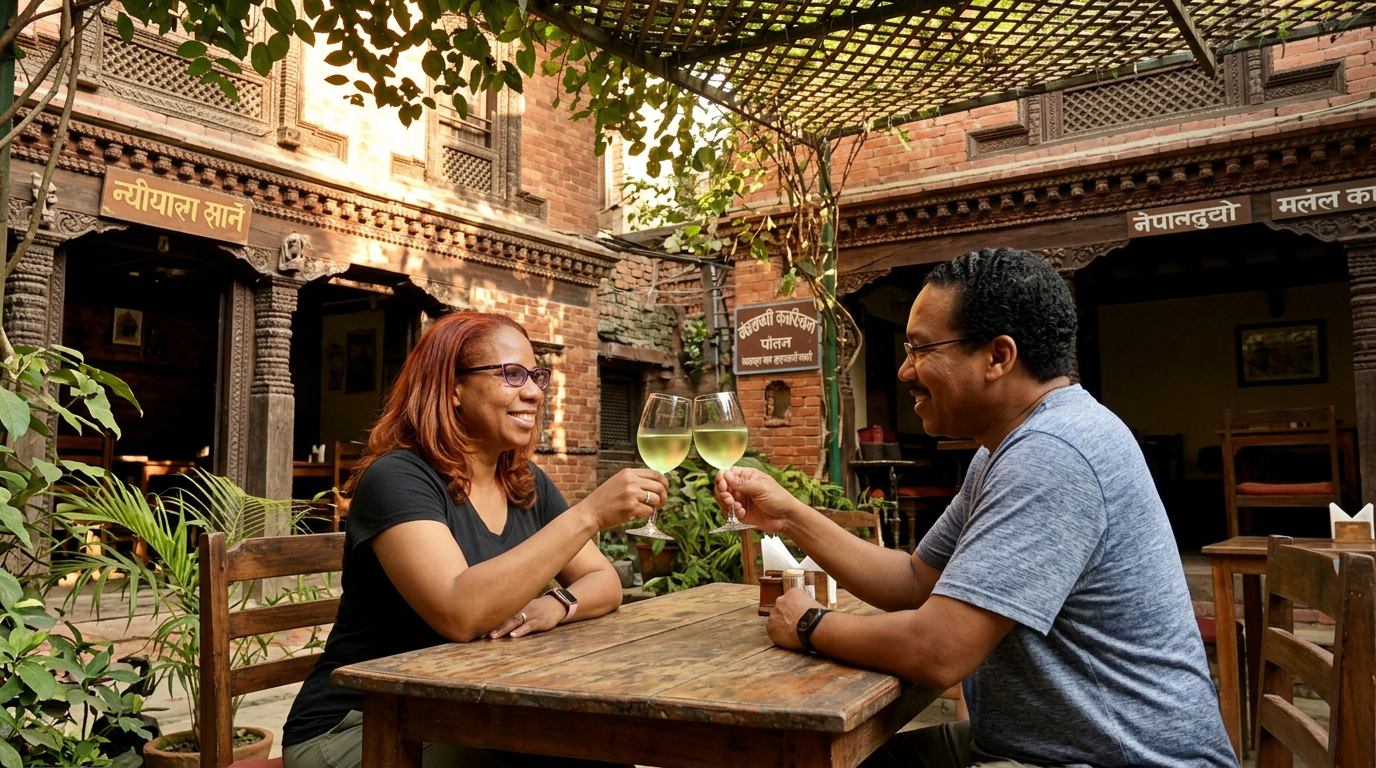
But the day wasn't done. While Nepal is famous for its mountains, I wanted to explore its surprising wine culture. Nepal actually produces its own wine now, which blew my mind. After a midday nap to recover from my early start, Tony and I took a taxi across the Bagmati River to Lalitpur, also known as Patan. We headed to a cozy, modern wine bar called The Yellow House. The owner was incredibly passionate and poured us a glass of Divine Wine, a red blend made right here in Nepal from imported grapes and local fruits, alongside a glass of Nettlesome, which is a unique local wine made entirely from wild Himalayan stinging nettles.
We sat in the leafy courtyard as the afternoon cooled down. I took a sip of the stinging nettle wine—which cost about 450 Rupees a glass. It was fascinating. It didn't taste like grape wine at all; it was light, slightly herbal, a bit earthy, and finished with a crisp, citrusy finish. It tasted like the hills. Tony preferred the red blend, which was bold and sweet, but for me, drinking wine made from Himalayan nettles in a hidden courtyard in Lalitpur was the kind of unexpected travel memory you can't write a script for. We sat there for hours, talking about how a city that seemed so hostile just twenty-four hours ago had completely won us over.
Vibrant, colorful, and sensory. Shots of bright orange marigolds at the market, steam rising from a cup of sweet milk tea, thousands of pigeons taking flight in Durbar Square, and the rich colors of the Nepali thali. Handheld and intimate.
As we walked back to our hotel that evening, the traffic was back in full force. The dust was thick, the horns were blaring, and the street vendors were calling out to us at every turn. But this time, I didn't feel anxious. I realized that the chaos of Kathmandu is just its outer shell. It is the protective armor of a city that has survived earthquakes, empires, and rapid modernization.
Underneath that noisy exterior is a heartbeat that is incredibly gentle, deeply spiritual, and welcoming to anyone willing to slow down and look for it. If you ever find yourself in Kathmandu, my biggest piece of advice is simple: buy a dust mask, pack your patience, and set your alarm for 4:30 AM. Walk those dark alleys, buy a cup of tea from a stranger, and watch the city wake up. I promise you, you will see a magic you will never forget.
A warm, direct-to-camera piece from Tara sitting on her hotel balcony at night, the soft lights of Kathmandu glowing behind her. She smiles, takes a sip of tea, and waves goodbye to the camera.
Shot List
| Type | Description | Audio | Duration |
|---|---|---|---|
| Wide | Establish shot of Kathmandu valley covered in a heavy morning mist with the Himalayas faintly visible in the extreme background at dawn. | Distant sound of temple bells and barking dogs. | 5s |
| Close-up | A burning clay butter lamp flickering in the dark on a stone ledge. | Soft, ambient wind. | 4s |
| Medium | Tara walking towards the camera down a dark, narrow, brick-walled alleyway, her face lit by her phone's flashlight. | Tara (whispering): 'It is just after 5 AM, and the old city is completely dark.' | 6s |
| Detail | An elderly woman’s hands gently placing a burning stick of incense at the base of a small, ancient stone shrine. | The soft whisper of a prayer. | 5s |
| Medium | Tara sitting on a low wooden bench at a market stall, cradling a small glasses of steaming hot milk tea. | Tara: 'This masala chiya is the warmest, most welcoming thing in the world right now.' | 7s |
| B-roll | Vibrant, fast-paced montage of the Asan Tole morning market: mounds of orange marigold flowers, bright red tomatoes, and green vegetables being unloaded. | Lively chatter of market vendors and shoppers. | 8s |
| Wide | Slow pan across Kathmandu Durbar Square as the golden morning sun hits the wooden carvings of the ancient temples. | Flapping wings of hundreds of pigeons. | 8s |
| Timelapse | Pigeons swirling in massive numbers in front of the Maju Deval temple staircase. | Uplifting, acoustic guitar music swells. | 6s |
| Overhead | A traditional Nepali Thali plate at Rosemary Kitchen, showing the colorful bowls of lentil soup, curries, and pickles. | Tony (off-camera): 'Wow, that looks incredible.' | 5s |
| Close-up | Tara taking a bite of the thali with her fingers, smiling warmly at the camera. | Tara: 'The depth of spices in this lentil soup is just unmatched.' | 6s |
| Medium | Tara and Tony sitting at a rustic wooden table in the leafy courtyard of The Yellow House in Patan. | Tara: 'We are trying wine made from wild Himalayan stinging nettles. Cheers!' | 7s |
| Detail | Light green, clear nettle wine being poured from a bottle into a clean wine glass. | The crisp sound of wine pouring. | 4s |
| B-roll | A busy Kathmandu street in the late afternoon, packed with honking motorbikes, colorful local buses, and pedestrians. | Loud, chaotic street noises and honking. | 5s |
| Medium | Tara direct-to-camera on her hotel balcony at night, looking relaxed and happy, with the distant city lights behind her. | Tara: 'Set your alarm, face the dark, and let Kathmandu surprise you. See you next week!' | 8s |
- Capture close-up details of hands: pouring tea, trading money at the market, spinning prayer wheels, and pouring wine.
- Get shots of the transition of light—from pitch black, to cool blue dawn, to warm golden sunlight hitting the brickwork.
- Record ambient audio everywhere: the silence of the dawn, the ringing of temple bells, the chatter of the market, and the roar of the afternoon traffic.
- Keep camera movements organic and handheld; avoid using a heavy tripod to blend in easily with the local crowd.
- 0:00 — Low, atmospheric, ambient pad music to match the dark, quiet morning walk.
- 1:30 — A gentle, acoustic guitar track starts to build as the city begins to wake up.
- 3:15 — Lively, upbeat local acoustic hand percussion and flute during the market scene.
- 5:00 — A majestic, swelling cinematic instrumental piece as the sun hits Durbar Square.
- 6:45 — Light, cheerful acoustic backing track during the thali lunch review.
- 8:00 — Relaxed, warm, indie-folk acoustic music during the wine tasting in Patan.
- 9:30 — Soft, reflective instrumental music for Tara's final balcony wrap-up.
- Start with very low, natural sound design in the cold open to emphasize the silence of the early morning.
- Use warm, golden-hour color grading for the Durbar Square sunburst shots to contrast with the cool, blue tones of the early morning.
- Keep cuts during the morning walk slow and atmospheric; speed up the cutting pace when the market begins and the traffic starts.
- Include subtle, clean lower-thirds for prices in both Nepalese Rupees (NPR) and US Dollars (USD) so viewers have easy context.
| Call | Provider | Model | Input Tokens | Output Tokens | Compute / Credits |
|---|---|---|---|---|---|
| Script | abacus.ai | gemini-3.5-flash | 1,642 | 4,189 | — |
| Image 1 — The Silent City | abacus.ai | nano_banana2 | — | — | 6,789.15 |
| Image 2 — A Morning Blessing | abacus.ai | nano_banana2 | — | — | 6,789.05 |
| Image 3 — Nettle Wine Tasting | abacus.ai | nano_banana2 | — | — | 6,846.75 |
I Crossed Continents Twice in 24 Hours (And Found Turkey’s Secret Wines) | Istanbul Vlog
I spent a day crossing between Europe and Asia on Istanbul's public ferries, braving the chaotic streets of Kadıköy, and discovering a side of Turkish wine I never knew existed.
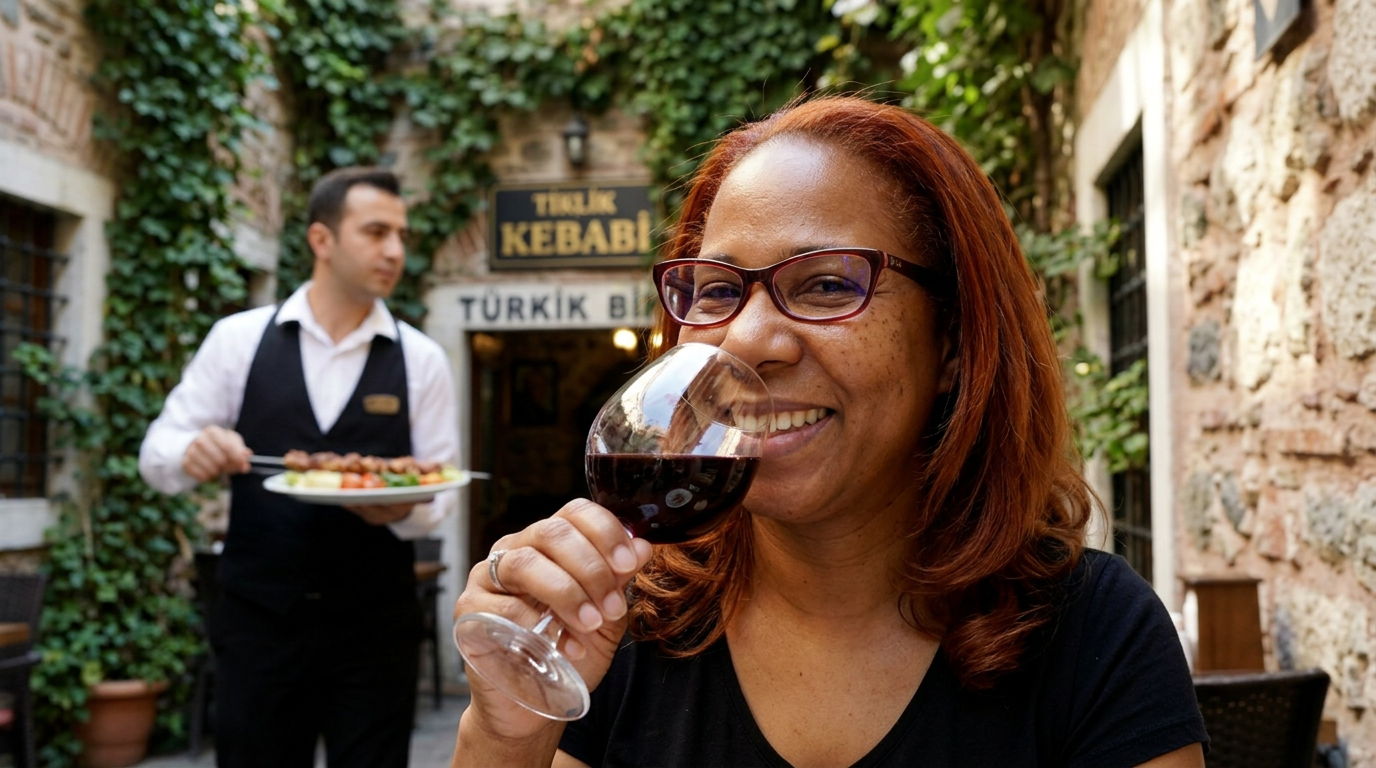
They say Istanbul is where East meets West, but standing on the deck of a public ferry with the salt spray of the Bosphorus in my face, it feels less like a meeting and more like a beautiful, chaotic dance. Today, my husband Tony and I are crossing between Europe and Asia twice in one day, and I'm on a mission to find a glass of wine that tells the story of this ancient crossroads.
Handheld shot of Tara on the windy deck of a yellow-and-white Istanbul ferry, her hair blowing, looking out at the silhouette of the Galata Tower in the distance, then panning down to her holding a tiny steaming glass of Turkish tea.
We woke up this morning to the sound of the morning Adhan echoing across Sultanahmet, casting this blue, misty light over the Hagia Sophia. To be honest, I was incredibly nervous before we landed here. Istanbul is massive—nearly sixteen million people—and the sheer scale of it, the language barrier, the legendary aggressive carpet salesmen, and the maze of public transit lines had me hyperventilating over my spreadsheets in Orlando. We are staying in a tiny, creaky hotel in the historical heart of the city, and our plan today is to completely ignore the tour buses and navigate the city like locals.
Tony and I decided to challenge ourselves: we wanted to experience both the European and Asian sides of the city in a single day, using nothing but public ferries and our own two feet. Our budget for the day is about 1,500 Turkish Lira, which is roughly fifty American dollars, to cover transit, street food, a real sit-down lunch, and whatever wine we can find. I’ve read that Turkey has some of the oldest grape-growing regions in the world, yet you rarely see Turkish wine on shelves back home. I wanted to find out why.
We started the morning by wrapping up warm—it’s a brisk fifty-four degrees today in early November, and I’ve got my trusty denim jacket, a heavy wool scarf, and my most beaten-up walking sneakers on. We walked down the steep, cobblestone hills from Sultanahmet toward the Eminönü ferry docks. The smell of roasted chestnuts and grilled mackerel from the floating fish-bread boats was absolutely intoxicating, but my stomach was fluttering with that familiar 'first-day-in-a-new-city' anxiety. Would we buy the wrong transit card? Would we end up on a boat to the Black Sea by mistake?
Naturally, we got confused immediately. The Eminönü terminal is a swirling sea of commuters, shouting vendors, and dozens of digital screens. We spent ten minutes trying to figure out the Biletmatik machine to get an Istanbulkart. A very kind transit worker saw me staring blankly at the Turkish instructions, tapped my shoulder, switched the machine to English for us, and helped us load fifty Lira onto a shared card. With a relieved 'Teşekkürler'—which I probably mispronounced terribly—we tapped through the turnstiles and boarded the ferry to Kadıköy on the Asian side.
The twenty-minute crossing was pure magic. For just about twenty-five Lira each, which is less than a dollar, we sat on the open-air deck. Seagulls chased the boat, diving for pieces of simit—the sesame-crusted bread rings—that passengers were tossing into the air. Watching the European skyline fade behind us while the modern, bustling docks of Asia approached made me realize how arbitrary borders really are. We stepped off the boat in Kadıköy and immediately felt a shift. It’s younger, artsier, and feels less like a museum and more like a living, breathing neighborhood.
We plunged into the Kadıköy Pazarı, the open-air market. The sensory overload was real: pyramids of bright red pomegranates, glistening green olives, piles of dried spices, and fishmongers splashing water on their fresh catches. We stopped at a tiny stall called Meşhur Danacı for lunch. No English menu, just a giant spinning spit of lamb döner. We gestured for two wraps and sat on low plastic stools on the sidewalk. It cost us 180 Lira total—about six dollars. The meat was juicy, spiced with sumac, wrapped in paper-thin lavash, and eaten while locals rushed past us. It was perfect.
After lunch, we wandered deep into the Moda neighborhood, which is full of leafy streets, lazy street cats sleeping on scooter seats, and cool indie coffee shops. It was here that we stumbled upon Solera Winery’s sister spot, a cozy, dimly lit wine bar called Viktor Levi. The courtyard was covered in ivy, hiding us from the street noise. I wanted to try something native, so I ordered a glass of Öküzgözü—which literally translates to 'bull's eye' because of the large, dark grapes. The server smiled when I tried to pronounce it.
The wine was a revelation. It cost about 140 Lira for a generous pour. It was medium-bodied, tasting of dark cherries and wild tea, with this dusty, earthy finish that felt like drinking the Turkish soil itself. Tony had a glass of Narince, a crisp, mineral-heavy white wine from Tokat that tasted like green apples and wet stones. Drinking wine in a country that is ninety-nine percent Muslim felt a bit hidden and rebellious, but the courtyard was filled with young Turkish couples laughing and clinking glasses. It felt incredibly welcoming.
By 4:00 PM, the sky started to turn a dusty rose color. We walked down to the Moda seaside cliffs, where hundreds of people were sitting on the giant rocks, drinking beers and tea, watching the sunset over the Marmara Sea. We joined them, just sitting in silence for a half hour, petting a friendly orange tabby cat that took a liking to Tony's lap. The wind was getting colder, reminding us we had to make our second crossing back to Europe before dark.
We took the ferry back, but this time we headed to Karaköy, on the northern side of the Golden Horn. The city under the moonlight was spectacular; the mosques on the hills were illuminated like floating crowns. But our peaceful mood evaporated when we stepped off the boat. Karaköy was packed, and Google Maps got completely turned around in the narrow alleys. We ended up walking up the incredibly steep, winding hill toward the Galata Tower three times, getting stuck in dead ends, our calves burning, and my hangriness starting to peak.
Just as I was about to call it a night and hunt for a taxi, we saw a small, warm glow coming from a doorway down a quiet side street. It was Sensus Wine Boutique. We slipped inside, leaving the cold wind and the crowds behind. The cellar-like room was lined with hundreds of local bottles, and the jazz music playing softly in the background instantly lowered my shoulders.
B-roll of the bustling Kadıköy market, close-ups of spices, pouring red wine into a glass at Viktor Levi, the sunset over the Marmara Sea, and the struggle of walking up the steep, cobblestone Galata hills at night.
We treated ourselves to a final, proper dinner at Sensus. We ordered a cheese board featuring local Turkish cheeses like Kars Gravyeri—a nutty, aged cow's milk cheese—and Divle Obruk, which is aged in caves and has a sharp, blue-like bite. To pair with it, the sommelier recommended a glass of Kalecik Karası, a grape variety that was almost lost to extinction but saved by local winemakers. It was light, elegant, and reminded me of a rustic Pinot Noir. The entire feast, including two glasses of wine each, cost us 950 Lira, about thirty-three dollars. It was worth every single penny.
Sitting there, warm and full, I realized how much my perspective of Istanbul had shifted in just twelve hours. This city can feel loud, intimidating, and impossibly fast. But beneath that exterior is a culture of deep hospitality, quiet corners of beauty, and a wine heritage that is fighting to be heard. We started the day terrified of the ferry machines, and ended it crossing continents like it was our daily commute.
If you are coming to Istanbul, my biggest piece of advice is to get lost on purpose. Buy the Istanbulkart, get on a ferry to Asia, eat the street food, and ask for a glass of Öküzgözü. Don't just look at the history through museum glass—go feel it on the streets. We are heading back to our hotel now, completely exhausted but so in love with this place. See you in the next adventure!
Medium shot of Tara raising her glass of Kalecik Karası to the camera in the cozy Sensus cellar, smiling, with Tony clinking his glass from off-camera. Fade out to a beautiful night shot of the illuminated Galata Tower.
Shot List
| Type | Description | Audio | Duration |
|---|---|---|---|
| Wide | The misty blue silhouette of the Hagia Sophia at sunrise, soft golden light breaking through the clouds. | [Ambient morning sounds, distant call to prayer echoing] | 5s |
| Medium | Tara standing on the street in Sultanahmet, wearing a denim jacket and wool scarf, speaking directly to the camera. | Tara: Good morning from Istanbul! Today, Tony and I are doing something a little crazy... | 12s |
| Detail | A close-up of a hand tapping an Istanbulkart on the yellow transit turnstile at Eminönü port. | [Loud electronic beep of the transit gate] | 3s |
| B-roll | Handheld tracking shot walking onto the large passenger ferry, the blue waters of the Bosphorus churning below. | [Loud hum of the ferry engine, rushing water] | 6s |
| Medium | Tara and Tony sitting on the outdoor ferry bench. Tony is tossing a piece of simit bread to a seagull flying alongside the boat. | Tara: Look at him go! He caught it mid-air! This is easily the best transit ride in the world. | 10s |
| Overhead | A top-down shot of the vibrant Kadıköy market stall: piles of bright pink pomegranates and green olives. | [Bustling market chatter, vendors shouting in Turkish] | 5s |
| Close-up | A sharp knife slicing incredibly thin ribbons of roasted lamb donor onto a piece of flatbread. | [Sizzling meat sound, paper wrapping rustling] | 4s |
| Medium | Tara sitting on a low plastic stool on a busy sidewalk, taking a huge bite of the döner wrap and smiling with her mouth half-full. | Tara: Oh my gosh. The sumac in this... it's so bright. Best six dollars we've ever spent. | 12s |
| Detail | Red wine being slowly poured into a large glass in the leafy, sun-dappled courtyard of Viktor Levi. | [Glug-glug sound of wine pouring, soft jazz music in background] | 5s |
| Medium | Tara holding the glass of red Öküzgözü wine up to the light, taking a sip, and looking thoughtful. | Tara: It's called Öküzgözü. It means bull's eye. It tastes like wild cherries and... almost like black tea. It's beautiful. | 15s |
| Timelapse | The sun setting over the historical peninsula of Istanbul, silhouetting the mosque minarets against an orange and purple sky. | [Lofi acoustic guitar music swells] | 8s |
| B-roll | Handheld POV walking up a very steep, dark cobblestone alleyway in Karaköy, the Galata Tower glowing at the top of the hill. | [Heavy breathing, footsteps on stone, city hubbub] | 7s |
| Detail | A close-up of a cheese knife cutting into a wedge of aged, yellow Kars Gravyeri cheese on a wooden board. | [Soft clinking of cutlery, warm restaurant chatter] | 4s |
| Medium | Tara sitting in the cozy, stone-walled cellar of Sensus, talking to the camera with her wine glass in hand. | Tara: We made it back to Europe, got incredibly lost, but found this absolute gem of a wine cellar. Cheers to getting lost. | 14s |
- Capture the sheer volume of street cats in Moda; get low shots of them resting on scooters or tables.
- Film the ferry wake—the churning turquoise water against the historic skyline makes for perfect transition footage.
- Get close-ups of hands in the market: pouring tea, scooping spices, slicing meat.
- Record the ambient soundscapes separately (ferry horns, market sellers, waves) to layer into the audio mix.
- 0:00 — Atmospheric, traditional Turkish ney flute and ambient city sounds.
- 1:15 — Upbeat, acoustic indie travel music as they walk toward the ferry docks.
- 2:45 — Light, breezy acoustic guitar and percussion during the ferry crossing to Asia.
- 4:20 — Energetic, modern folk rhythm through the bustling Kadıköy market scene.
- 6:10 — Warm, jazzy lounge music as they enter the Viktor Levi courtyard.
- 7:45 — Nostalgic, slow tempo lofi music during the sunset on the Moda cliffs.
- 9:15 — Cozy, warm jazz trio (piano and double bass) inside the Sensus wine cellar.
- Keep the pacing brisk during the transit parts to mimic the energy of the city, but slow down significantly during the wine tastings.
- Use elegant, minimalist text overlays for the prices in both Turkish Lira and US Dollars.
- Enhance the natural sound design: let the ferry horns, seagull cries, and clinking wine glasses be loud in the mix.
- Apply a warm, golden color grade to the afternoon scenes in Moda to emphasize the autumn light.
| Call | Provider | Model | Input Tokens | Output Tokens | Compute / Credits |
|---|---|---|---|---|---|
| Script | abacus.ai | gemini-3.5-flash | 1,645 | 4,512 | — |
| Image 1 — The Sunrise of Sultanahmet | abacus.ai | nano_banana2 | — | — | 6,788.05 |
| Image 2 — The Bosphorus Crossing | abacus.ai | nano_banana2 | — | — | 6,845.95 |
| Image 3 — Discovering Turkish Wine | abacus.ai | nano_banana2 | — | — | 6,788 |
I Got Completely Lost in Marrakech (And Why You Should Too)
I went to Marrakech expecting chaos, got hopelessly lost in the medina, and found the magic of Morocco the second I stopped looking at my map.
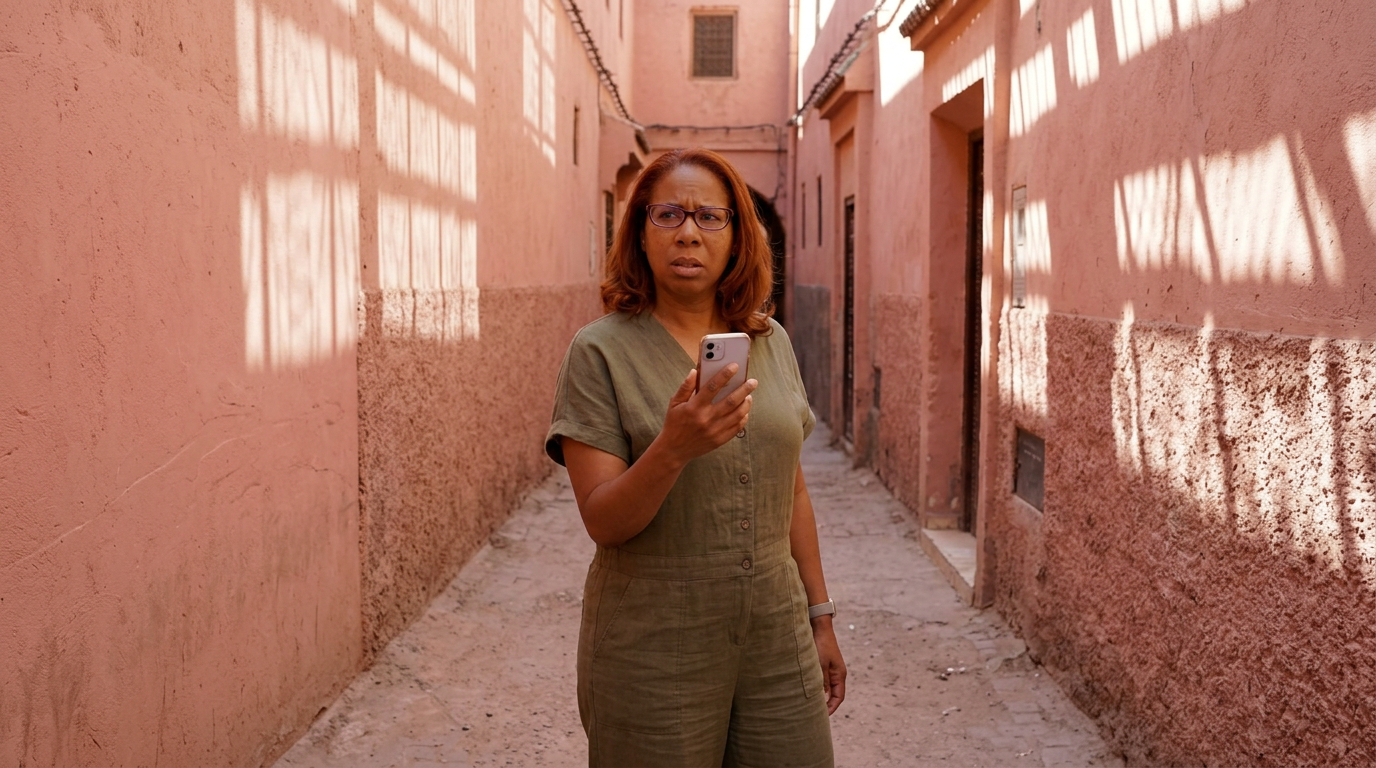
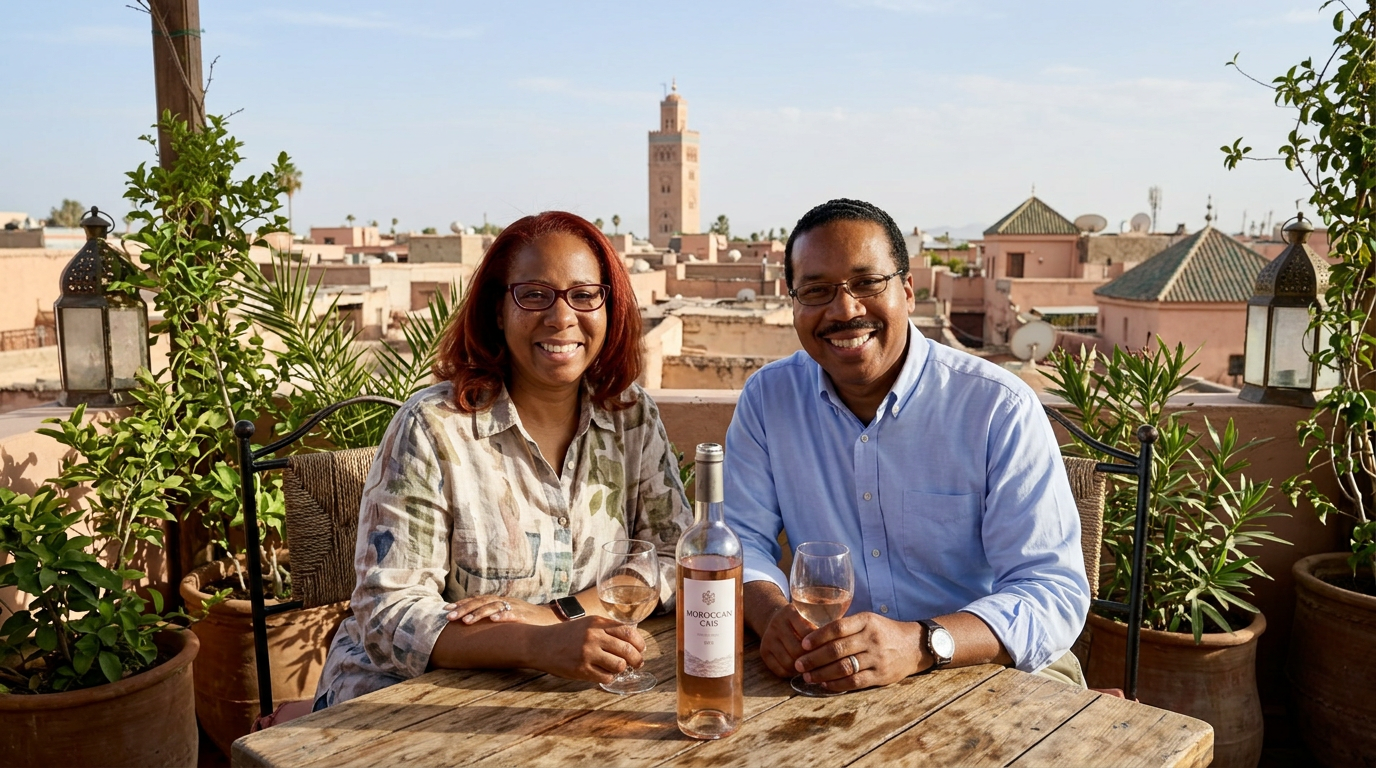
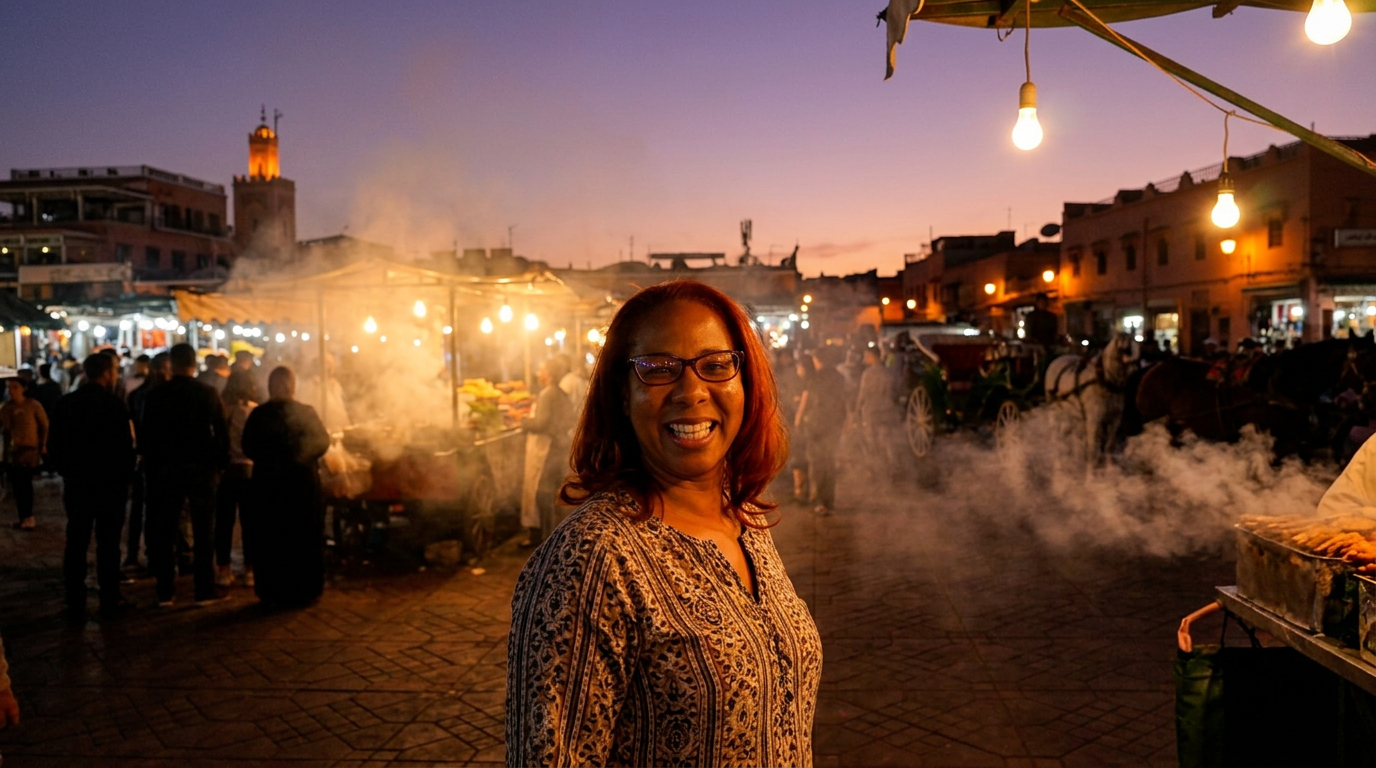
They told me the medina of Marrakech was a labyrinth, but I didn't realize that meant my phone's GPS would completely give up by noon. It turns out, getting hopelessly lost was the best thing that could have happened to me.
Handheld, slightly shaky camera following Tara from behind as she navigates a narrow, bustling pink-walled alleyway in Marrakech, dodging a passing motorbike, looking back at the camera with a mix of wide-eyed panic and a laugh.
I have to admit, standing in the Orlando airport three days ago, my stomach was doing flip-flops. I am a planner. I like itineraries, color-coded maps, and knowing exactly which train turnstile to use. Marrakech, Morocco was a destination that both thrilled me and absolutely terrified me. Tony and I had talked about coming here for years, but as we finally boarded our flight, the sheer scale of navigating a medieval, car-free mud-brick maze with over nine thousand alleys felt like a test I hadn't studied for.
We landed at the gorgeous Menara Airport on a Tuesday afternoon. The sky was an intense, cloudless blue, and the air smelled instantly different—like dry heat, dust, toasted cumin, and diesel. We checked into a beautiful, quiet little Riad called Riad Yasmine in the northern part of the medina. Standing in that peaceful courtyard with its emerald green pool and chirping birds, the chaos of the outside world felt miles away. But to get anywhere, we had to step back out through that heavy wooden door.
Our plan for our first full day was simple, or so I thought. We were going to walk south through the souks, visit the historic Bahia Palace, and then find a quiet rooftop for a late lunch. I carried my trusty leather crossbody bag, wore a breathable olive-green linen jumpsuit, and had my phone clutched in my hand like a lifeline. Tony had the camera rig, wearing his light grey linen shirt, looking far more relaxed than I felt. I was determined not to get scammed, not to get run over by a scooter, and absolutely not to get lost.
Spoiler alert: within twenty minutes of leaving the Riad, the blue dot on my Google Maps started spinning in frantic circles. The towering clay walls, painted in every shade of dusty rose and terracotta, blocked the satellite signal. Streets that looked like major thoroughfares on my screen turned out to be dead-ends ending in private doorways. We were officially off-grid, and the heat was rising to 32 degrees Celsius. My chest tightened, and I could feel the familiar prickle of travel anxiety.
We spent the next forty-five minutes trying to correct our course, which only plunged us deeper into the labyrinth. Every alley looked identical, yet completely unique. Men in hooded djellabas swept the dusty ground, sleeping cats draped themselves over colorful piles of hand-woven Berber rugs, and the sound of hammering metal echoed from hidden courtyards. Every time I tried to stop and look at my useless phone, young boys would politely—and sometimes insistently—offer to show us the way to 'the big square' for a fee. I'd read about the helper scams, so I kept saying 'La, shukran'—no, thank you—with a tight, nervous smile.
Around 1:00 PM, we stumbled into a small, dusty square where three elderly men were sitting on wooden crates drinking mint tea. I was dusty, sweating through my linen, and incredibly frustrated. Tony looked at me, put his hand on my shoulder, and said, 'Tara, put the phone in your bag. Let's just walk.' It was like a physical release. I slipped my phone away, took a deep breath, and actually looked up. Really looked up. The sunlight was filtering through slatted bamboo roofs, casting beautiful zebra-stripes of shadow and light across mountains of bright orange turmeric and deep red paprika.
Suddenly, without the pressure of a destination, the medina transformed from a hostile maze into a living museum. We stopped at a tiny wooden stall where an artisan named Youssef was hand-carving cedarwood spoons using his foot to spin a lathe. We couldn't speak Arabic or French, and he didn't speak English, but we smiled, pointed, and watched his incredible craftsmanship. I bought two beautifully fragrant cedar spoons for 50 Dirhams—about five US dollars—and he gave us the warmest, toothless smile that instantly melted my lingering tension.
By 2:30, our stomachs were growling. We followed the rich, savory scent of roasting meat and found ourselves outside a tiny, unassuming restaurant called Chez Lamine Hadj Mustapha, tucked away down an alley near the spice souk. It was packed with locals, which is always the ultimate sign of good food. There were no English menus, just a giant clay jar cooking in an underground pit of hot coals. This was Mechoui—slow-roasted lamb that cooks for hours until it literally falls off the bone.
We ordered a quarter-kilo of the Mechoui, which was served on a simple sheet of butcher paper with a side of cumin, salt, and flatbread, costing us about 90 Dirhams. No forks, no knives. We sat at a communal wooden bench, the room loud with conversational Arabic and the clinking of glasses. I took a piece of the warm bread, pinched off a piece of the lamb, dipped it in cumin, and took a bite. It was incredibly rich, smoky, and melt-in-your-mouth tender. It was easily one of the best things I have ever eaten in my life, worth every bit of the sweat it took to find it.
After lunch, we needed to escape the intense afternoon heat. Morocco is an Islamic country, so finding alcohol in the medina can be a bit of a treasure hunt, but many riads and upscale rooftops hold liquor licenses. We navigated toward the southern edge of the medina, using the towering minaret of the Koutoubia Mosque as our compass, and found Kabana, a stylish rooftop oasis. It felt like a different world—lush green plants, cool misting fans, and a view of the Atlas Mountains shimmering in the distance.
I wanted to try something local, so I ordered a glass of Moroccan gris wine—specifically, a bottle of Domaine de la Saharienne Guerrouane Gris from the foothills of the Atlas Mountains, which cost 80 Dirhams. Let me tell you, this was a revelation. It’s not quite a rosé and not quite a white; it’s a pale, salmon-pink wine made from Cinsault and Grenache grapes. It was bone-dry, incredibly crisp, with notes of wild strawberry and a salty, mineral finish that was absolutely perfect for a hot afternoon. We sat there for an hour, watching the storks nest on the ancient ramparts, completely relaxed.
Feeling restored, we set out for our afternoon activity. Since we had completely missed our morning window for the Bahia Palace, we decided to wander toward the Le Jardin Secret. Located right in the heart of the Mouassine neighborhood, it’s an elegant 19th-century palace complex that was restored in 2016. Admission was 80 Dirhams each. Stepping inside felt like walking into a living green sanctuary.
The garden is split into an exotic garden filled with plants from all over the world, and an Islamic garden, which is designed according to the description of paradise in the Quran. The sound of trickling water from the marble fountains, the scent of rosemary and lavender, and the geometric precision of the green Zellij tiles was mesmerizing. We sat on a marble bench under the shade of a fig tree, just listening to the water. It was the perfect contrast to the frantic energy of the souks outside.
A vibrant montage of Marrakech: close-ups of colorful spice cones, hands weaving clay pots, the steam rising from the underground lamb pits, pouring hot mint tea from high above, and Tara smiling as she sips her cold glass of gris wine on the breezy rooftop.
As the sun began to dip below the horizon, painting the sky in shades of dusty mauve and gold, we finally made our way to the famous Jemaa el-Fnaa square. During the day, it’s a vast, empty expanse, but at night, it transforms into a theatrical spectacle. Smoke from dozens of food stalls filled the air, snake charmers played their flutes, musicians gathered in circles playing Gnaoua music, and the energy was electric. Earlier in the day, this would have overwhelmed me. Now, I just felt incredibly lucky to be standing in the middle of it.
If you are planning a trip to Marrakech, my biggest piece of advice is this: let go of the control. Pack a physical map if you must, but prepare to put it away. Wear comfortable shoes, cover your shoulders, keep your cash in a secure inner pocket, and give yourself permission to get lost. The real magic of this city isn't found in the tourist checkpoints; it’s found in the wrong turns, the shared smiles when language fails, and the quiet courtyards waiting just behind the most chaotic alleys.
We headed back to our Riad under a canopy of stars, our feet dusty and our hearts incredibly full. I came to Marrakech looking for a checklist of sights, but I left with something much better: a reminder that sometimes, losing your way is the only way to truly find where you are. Thanks for watching, guys. Don't forget to subscribe, and I'll see you on the next adventure!
Tara sits on the edge of the Riad pool at night, lanterns glowing around her, dipping her bare feet in the water. She looks at the camera, raises a small glass of mint tea in a toast, and smiles warmly as the shot slowly pulls back and fades to black.
Shot List
| Type | Description | Audio | Duration |
|---|---|---|---|
| Wide | The chaotic, rose-colored alleyways of the Marrakech medina, filled with pedestrians and a looming motorcycle. | [Ambient sounds of bustling souk, motorbike engines, distant call to prayer] | 5s |
| Close-up | Tara's face, showing a mix of stress and excitement as she looks at her spinning phone compass. | Tara (VO): They told me the medina was a labyrinth, but I didn't realize my GPS would completely give up by noon. | 4s |
| Medium | Tara and Tony standing inside the quiet, green tiled courtyard of Riad Yasmine. | Tara: Standing in this peaceful courtyard, the chaos outside felt miles away. | 6s |
| B-roll | A close-up of colorful towers of spices (turmeric, paprika, cumin) sitting in woven baskets outside a shop. | [Upbeat, acoustic Gnawa-inspired travel music begins playing quietly] | 5s |
| Medium | Handheld shot of Tara walking down a sun-dappled alleyway, reaching out to touch a hanging wool rug. | Tara (VO): Once I put my phone away, the medina transformed from a hostile maze into a living museum. | 7s |
| Close-up | Youssef's hands using a traditional foot-lathe to carve a cedarwood spoon, shavings flying off the wood. | [Sound of wood carving and light laughter between Tony and Youssef] | 6s |
| Overhead | A plate of rich, steaming roasted Mechoui lamb served on simple butcher paper with small bowls of cumin and salt. | [Sizzling kitchen sounds, chatter in Arabic in the background] | 5s |
| Detail | Tara tearing off a piece of flatbread, grabbing a piece of tender lamb, and taking a bite, closing her eyes in delight. | Tara: This is easily one of the best things I have ever eaten in my life. | 7s |
| Wide | The view from Kabana rooftop, looking out over the dusty rooftops of Marrakech toward the hazy Atlas Mountains. | [Lounge music blending with the distant hum of the city] | 6s |
| Medium | A chilled bottle of Guerrouane Gris being poured into a clean wine glass on a wooden table at the rooftop bar. | Tara (VO): I ordered a glass of Moroccan gris wine. It was bone-dry, crisp, and perfect for a hot afternoon. | 6s |
| Timelapse | The shadows lengthening across the geometric green tiled walkways of Le Jardin Secret. | [Sound of trickling water from a marble fountain] | 8s |
| Medium | Tara sitting on a marble bench in the garden, looking up at a fig tree, taking a deep, relaxed breath. | Tara (VO): Stepping inside felt like walking into a living green sanctuary. | 6s |
| Wide | Jemaa el-Fnaa square at dusk, with smoke rising from dozens of food stalls under a deep purple sky. | [Loud drumming, street musicians, crowd chatter, sizzling grills] | 7s |
| Close-up | A glass of hot mint tea being poured from a silver teapot held high above, creating a perfect foam on top. | Tara (VO): Sometimes, losing your way is the only way to truly find where you are. | 6s |
- Capture plenty of textures: macro shots of spices, the roughness of the pink mud-brick walls, and the smooth glaze of the Zellij tiles.
- Keep the camera moving naturally: use slow walking shots through the souks to mimic the feeling of exploring on foot.
- Film the food preparation: get close-ups of the giant clay pots (tangia/mechoui) being pulled from the underground embers.
- Record ambient audio at every stop: the metallic clatter of the brass souk, the fountain in the garden, and the chaotic music of Jemaa el-Fnaa.
- 0:00 — Atmospheric, mysterious hand percussion and oud intro to build tension during the cold open.
- 0:45 — Transition to light, upbeat acoustic guitar and hand drums as Tara describes arriving at the Riad.
- 2:15 — Slightly tense, fast-paced djembe rhythm as they get lost in the maze of the souks.
- 3:50 — Warm, mellow traditional Gnawa music (gimbri and qraqeb) as they stop trying to find their way and meet the woodcarver.
- 5:30 — Playful, rhythmic acoustic music during the lunch scene at Chez Lamine.
- 7:10 — Chill, jazzy lounge music with a subtle Arabic flute hook for the rooftop wine tasting.
- 8:40 — Serene, minimalist ambient pads and soft string sounds for the peaceful Jardin Secret segment.
- 9:30 — Energetic, festive traditional Moroccan street music to match the high energy of Jemaa el-Fnaa at night.
- Pacing should mirror Tara's mental state: fast, quick cuts during the initial 'lost' phase, slowing down significantly once they decide to relax and enjoy the journey.
- Use subtle, clean lower-thirds to display location names (e.g., 'Chez Lamine Hadj Mustapha' or 'Le Jardin Secret') and prices in both Moroccan Dirhams (MAD) and US Dollars (USD).
- Enhance the sensory experience by boosting the natural ambient audio (scooter engines, sizzling meat, trickling water) during B-roll transitions.
- Apply a warm, golden-hour color grade throughout the video to emphasize the beautiful pink and orange tones of the Marrakech clay architecture.
| Call | Provider | Model | Input Tokens | Output Tokens | Compute / Credits |
|---|---|---|---|---|---|
| Script | abacus.ai | gemini-3.5-flash | 1,641 | 4,754 | — |
| Image 1 — The Medina Maze | abacus.ai | nano_banana2 | — | — | 6,788.75 |
| Image 2 — The Rooftop Toast | abacus.ai | nano_banana2 | — | — | 6,846.6 |
| Image 3 — Jemaa el-Fnaa at Dusk | abacus.ai | nano_banana2 | — | — | 6,788.55 |
I Ate My Way Through Mexico City (And Found the Wine Everyone's Missing)
I spent a day wandering Mexico City's leafy neighborhoods, eating five incredible meals, and discovering a vibrant Mexican wine scene that blew me of out of the water.
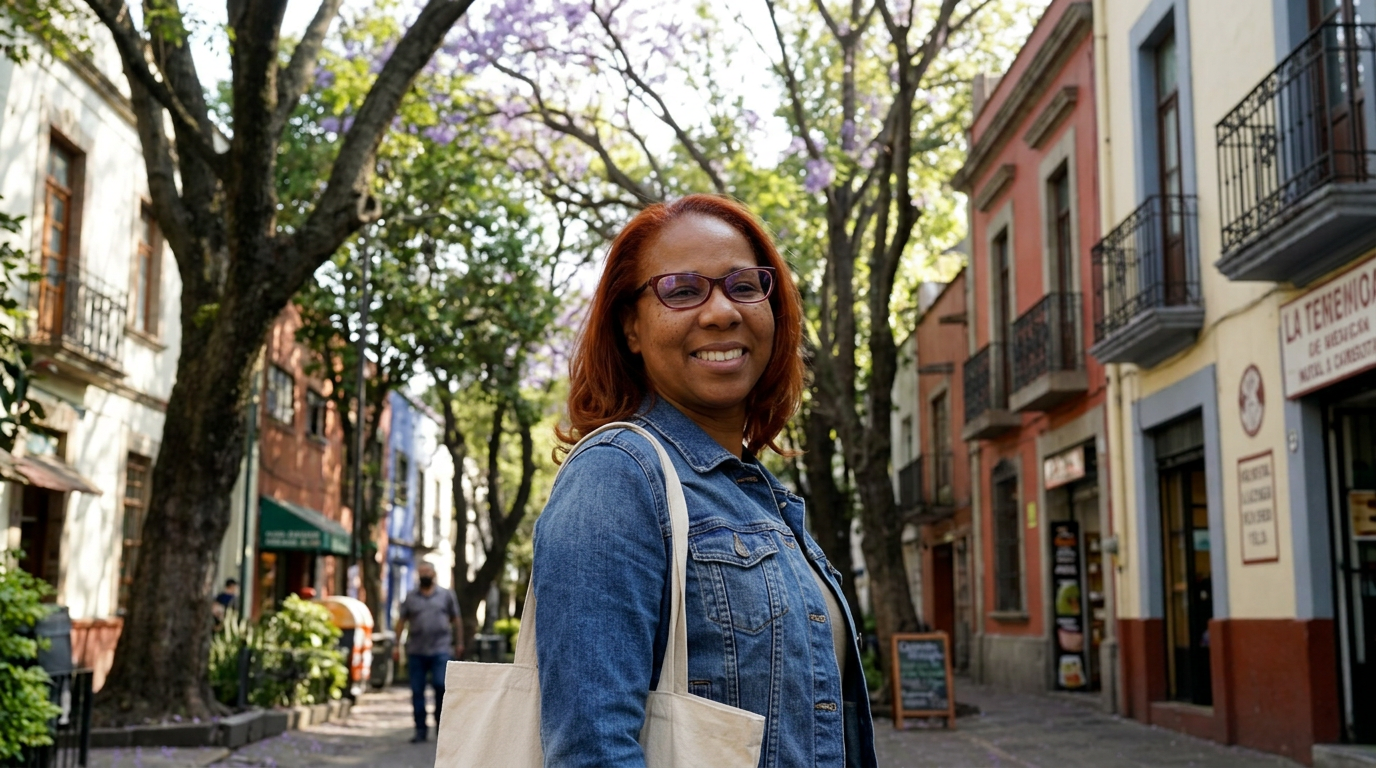
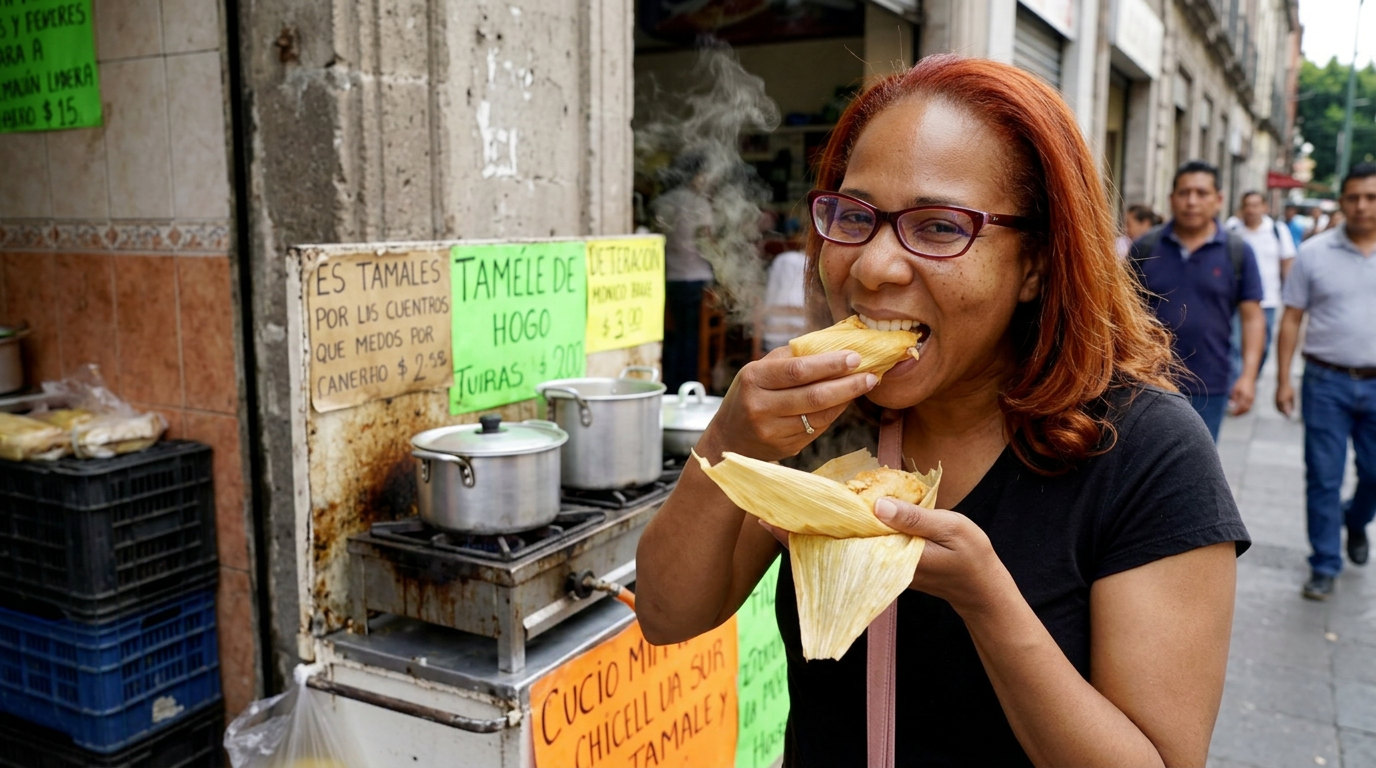
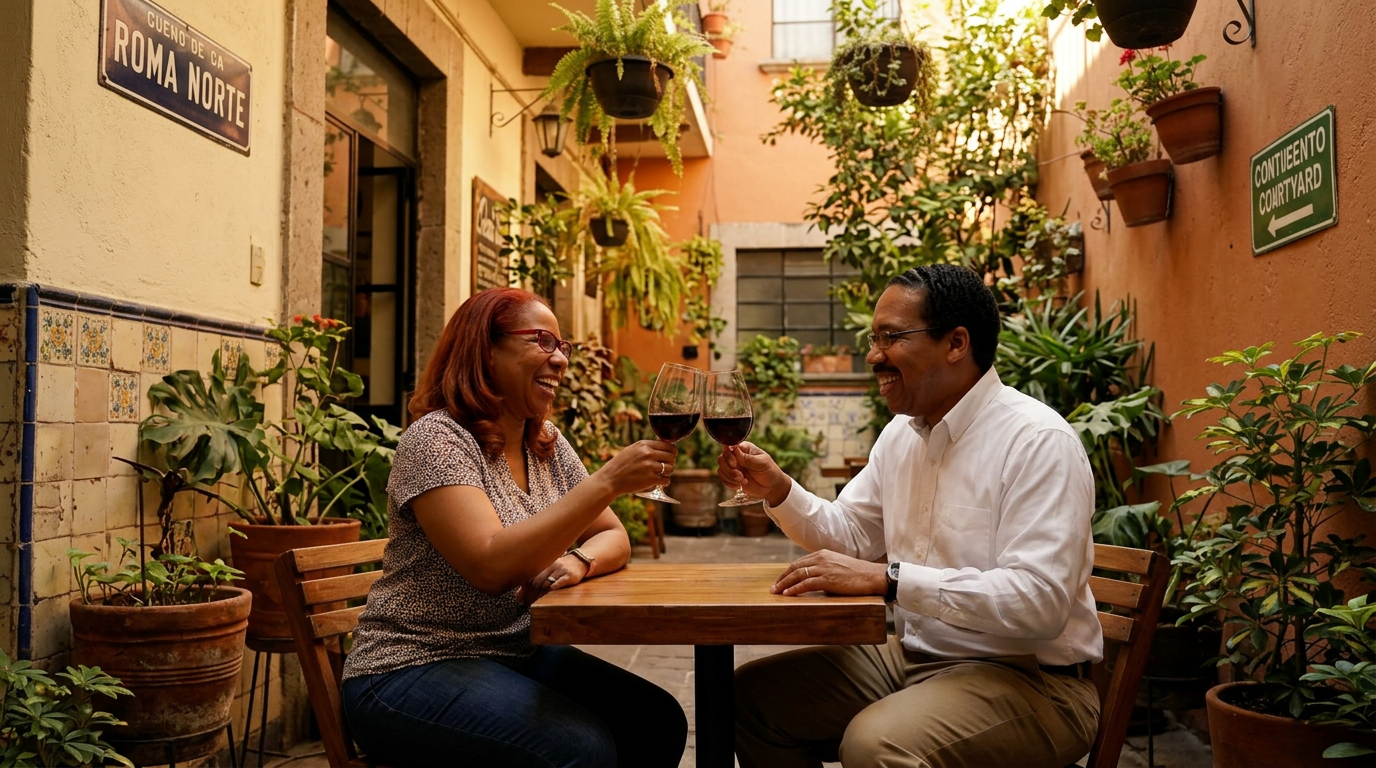
Everyone told me to come to Mexico City for the street tacos, but nobody warned me that I’d fall completely in love with a glass of red wine from Baja California in a hidden courtyard in Roma Norte.
Handheld shot of Tara smiling, holding a glass of dark red wine against a background of lush green plants in a tiled courtyard, then taking a sip and looking at the camera with wide eyes.
I have to confess something. Before Tony and I boarded our flight from Orlando to Mexico City, I was incredibly nervous. At thirty-five, I’ve traveled a decent amount, but CDMX always felt so massive, so fast-moving, and honestly, a little intimidating. I worried about my rusty high school Spanish, I worried about getting lost in a city of twenty-two million people, and I worried my stomach wouldn't handle the legendary street food. We landed at Benito Juárez International Airport on a crisp Thursday morning, the air thin and cool at over seven thousand feet above sea level, and my heart was beating a mile a minute.
We dragged our suitcases into an Uber—which, by the way, is incredibly cheap and easy here, costing us about two hundred and fifty pesos, or fourteen dollars, to get to our hotel. We stayed in Condesa, a neighborhood that instantly felt like a dream. It’s filled with art deco buildings, massive jacaranda trees that paint the streets purple in spring, and dog walkers everywhere. The nervous tension in my shoulders immediately started to melt as we walked down Avenida Ámsterdam, a circular street built on an old horse racing track.
My plan for the day was ambitious, maybe foolishly so: I wanted to eat at five different places, spanning from humble street stalls to a modern bistro, and track down the local wine culture. When people think of Mexico, they think of tequila and mezcal—which are great—but as a wine lover, I knew Baja California’s Valle de Guadalupe was producing some incredible bottles, and I wanted to see how the capital’s cool culinary scene was pouring them. Tony was more than happy to act as my co-pilot and camera operator, provided he got to eat his weight in tlacoyos.
Armed with a canvas tote bag, a light denim jacket to cut the morning chill, and a healthy dose of curiosity, we set out on foot. No tour guides, no fancy private cars. Just us, a map on my phone, and a massive appetite. I wanted to see if this overwhelming metropolis could feel intimate, and if a couple of Floridians could find their groove in one of the world's greatest food capitals.
Our first stop was just a few blocks from our hotel at a tiny, no-nonsense corner stall called Tamales Doña Emi. The line was six people deep, mostly locals in business suits grabbing breakfast before work. I nervously ordered two tamales in my broken Spanish: one 'verde' with shredded chicken and salsa verde, and one 'dulce' with pineapple for Tony, which cost us just seventy pesos total—less than four dollars. We ate them standing on the sidewalk, grease on our fingers, the steam rising into the cool morning air. The masa was impossibly light and fluffy, nothing like the heavy tamales I've had back home. It was the perfect, comforting start to the day.
To walk off breakfast, we headed north toward Roma Norte, Condesa’s slightly edgier, incredibly stylish sibling neighborhood. We walked along Calle Colima, popping into independent design shops and admiring the stunning architecture. Our destination was the Mercado de Medellín, a bustling traditional market. Inside, the sensory overload was real: mountains of bright yellow mangoes, stalls draped in dried chiles, and the rhythmic thumping of butchers' knives. We navigated the narrow aisles, dodging vendors pushing handcarts, until we found a small stall selling fresh fruit cups. For forty pesos, we got a massive cup of fresh jicama, cucumber, and watermelon doused in lime juice and Tajín.
By 1:00 PM, the sun was high and the temperature had warmed up to a perfect seventy-five degrees. It was time for lunch number three. We walked over to Contramar, a legendary seafood institution in Roma. Now, getting a table here without a reservation is notoriously difficult, but we showed up just as they opened and snagged two seats at the bar. The room was loud, energetic, and filled with the clinking of glasses. We ordered their signature tostada de atún—raw tuna, crispy onions, avocado, and chipotle mayo on a crunchy tortilla. At two hundred and eighty pesos for a plate of four, it was a splurge, but one bite of that buttery tuna explained why this place has been famous for decades.
After the buzz of Contramar, we needed a quiet moment. We took a thirty-minute walk down to Bosque de Chapultepec, a park double the size of Central Park in New York. We paid ninety-five pesos each to enter the Chapultepec Castle, which sits on top of a hill with a breathtaking view of the Paseo de la Reforma. Standing on the grand stone terrace, surrounded by lush gardens where Mexican emperors once walked, the sheer scale of the city hit me. It stretched out to the mountains in every direction, a beautiful, sprawling grid of life.
By late afternoon, my feet were aching and I was ready for that wine. We headed to Hugo el Vino, a cozy, low-lit natural wine bar in Roma Norte with sidewalk tables. This is where the magic happened. The sommelier, a friendly guy named Mateo, smiled when I asked for something local. He brought out a bottle of Bichi 'No Sapiens', a natural red wine made from mysterious, unidentified grapes in Tecate, Baja California. It cost two hundred and twenty pesos a glass. It was funky, bright, tasting of wild cherries and damp earth, totally unpretentious and deeply delicious. Sitting on that sidewalk, watching people walk their dogs as the golden hour light filtered through the trees, was the exact moment I realized I had fallen head over heels for this city.
We couldn't end the day without a proper dinner, which brought us to stop number five: Lardo, a beautiful, casual restaurant in Condesa run by acclaimed chef Elena Reygadas. The space is gorgeous, with a long copper bar and open kitchen. We didn't have a reservation, but we managed to get two spots at the bar after a twenty-minute wait. We ordered a wood-fired flatbread with wild mushrooms and local goat cheese, paired with another incredible Mexican wine—a crisp, mineral-forward Chenin Blanc from Casa Magoni in the Valle de Guadalupe. The meal came to about nine hundred pesos, or fifty dollars, and was worth every single cent.
As we walked back to our hotel under a canopy of twinkling streetlights, our stomachs full and our hearts light, I couldn't help but laugh at how nervous I had been just twelve hours earlier. The city hadn't chewed us up; it had welcomed us with open arms, incredible flavors, and a glass of wine I'll be dreaming about for years.
A sweeping montage of street life in Roma and Condesa: colorful buildings, bustling market stalls, plates of beautiful food being served, wine being poured into glasses, and close-ups of Tara laughing and talking to the camera.
If you’re planning a trip to Mexico City, my biggest piece of advice is to let go of your itinerary and let your appetite guide you. Don't just stick to the tourist guides; ask the locals what they're drinking and where they're eating. The food here is a world-class masterpiece, whether it’s served on a paper plate on a street corner or on ceramic dinnerware at a trendy bistro.
And please, do not leave without trying the domestic wine. The Valle de Guadalupe is producing some of the most exciting, rebellious, and delicious bottles in the world right now, and CDMX is the perfect place to discover them. Mexico City isn't a place to be feared; it's a place to be savored, one bite, one sip, and one wrong turn at a time.
Tara is sitting on a park bench in Condesa at dusk, speaking directly to the camera with a warm, authentic expression. The background lights are softly blurred. The camera slowly zooms out as she says her sign-off.
Shot List
| Type | Description | Audio | Duration |
|---|---|---|---|
| Wide | Establishing shot of Avenida Ámsterdam in Condesa, dappled morning sunlight filtering through the dense green canopy of trees. | Ambient sounds of birds chirping and distant city traffic hum. | 5s |
| Medium | Tara stands on the sidewalk in a denim jacket, looking slightly nervous but smiling, holding her phone map. | Tara (VO): 'I have to confess something. Before Tony and I boarded our flight from Orlando, I was incredibly nervous.' | 6s |
| Close-up | Steam rising from a large metal pot at Tamales Doña Emi; hands wrapping a hot tamale in a corn husk. | Sizzling and bubbling sounds, chatter of patrons in Spanish. | 4s |
| Detail | Tara takes a bite of the chicken verde tamale, closing her eyes in appreciation. Tony's hand is visible holding his pineapple tamale. | Tara: 'Oh my gosh, that is unbelievably light. It's like a cloud. Nothing like the heavy ones back home.' | 7s |
| B-roll | Handheld walking shot through Mercado de Medellín, passing stacks of vibrant yellow mangoes and hanging dried chiles. | Lively market music, vendors shouting prices, general bustle. | 5s |
| Overhead | A plate of four iconic tuna tostadas at Contramar, arranged beautifully with crispy onions on top. | Clinking glasses and loud restaurant chatter. | 4s |
| Medium | Tara at the Contramar bar, taking a bite of the tostada. She looks at Tony behind the camera with wide eyes and nods emphatically. | Tara: 'That buttery tuna with the smoky chipotle... I get the hype. I completely get it.' | 8s |
| Timelapse | Clouds moving over the grand stone terrace of Chapultepec Castle, looking out over the sprawling skyline of Mexico City. | Wind blowing gently, transition music swells. | 6s |
| Detail | Red wine being poured from a minimalist Bichi bottle into a glass at a rustic outdoor table at Hugo el Vino. | The sound of wine glugging into the glass, street sounds in the background. | 4s |
| Medium | Tara sitting at the outdoor table, holding the glass of red wine up to the light, taking a sip, and smiling warmly. | Tara: 'It's funky, wild, and tastes like fresh cherries. This is Mexican wine, and it is absolutely brilliant.' | 8s |
| Close-up | A chef at Lardo sliding a wood-fired flatbread topped with wild mushrooms out of a roaring copper oven. | The crackle of the wood fire and kitchen orders being called out. | 5s |
| Wide | Tara and Tony sitting side-by-side at the beautiful copper bar of Lardo, clinking their wine glasses together in a toast. | Tara: 'To getting lost, eating well, and finding our new favorite city.' Tony: 'Salud!' | 6s |
| Medium | Tara sitting on a park bench in Condesa at dusk, speaking directly to the camera as the soft streetlights begin to glow. | Tara: 'Don't just stick to the tourist guides. Let this city surprise you. It's a place to be savored, one bite at a time.' | 10s |
- Capture plenty of street-level movement: dog walkers in Condesa, vendors setting up stalls, and patrons chatting outside cafes to emphasize the neighborhood vibe.
- Get extreme close-ups of food textures: the steam rising from the tamales, the glistening glaze on the tuna tostadas, and the cheese melting on the hot flatbread.
- Film the wine labels clearly when the sommelier pours them, allowing viewers to see the unique branding of the Baja California wineries.
- Shoot continuous walking shots with a stabilizer down the colorful streets of Roma Norte to give a sense of exploration and scale.
- 0:00 — Soft, upbeat acoustic guitar and light percussion to introduce the warm, inviting vibe of Condesa.
- 1:45 — Lively, brassy traditional Mexican mariachi-infused acoustic tempo during the tamale breakfast scene.
- 3:20 — Rhythmic, high-energy jazz with a Latin beat as Tara navigates the bustling Mercado de Medellín.
- 5:10 — Elegant, sweeping orchestral and acoustic arrangement during the Chapultepec Castle viewpoint sequence.
- 6:45 — Chill, jazzy lo-fi beats with a smooth bass line for the relaxed wine tasting at Hugo el Vino.
- 8:30 — Upbeat, sophisticated indie-folk track building excitement during the dinner at Lardo.
- 9:40 — Warm, reflective acoustic guitar that slowly fades out as Tara gives her final thoughts and sign-off.
- Maintain a warm, organic color grade with rich greens and golden tones to reflect the lush foliage and sunny weather of Mexico City.
- Keep the transition from the busy market to the quiet castle smooth, using a brief beat of silence or wind sound effects to emphasize the contrast.
- Use clean, minimalist lower-third text overlays to display the prices in both Mexican Pesos (MXN) and US Dollars (USD) as foods are introduced.
- Ensure the audio design captures the authentic street atmosphere—honking horns, distant chatter, and sizzling food—but keep Tara's voiceovers crisp and clear.
| Call | Provider | Model | Input Tokens | Output Tokens | Compute / Credits |
|---|---|---|---|---|---|
| Script | abacus.ai | gemini-3.5-flash | 1,646 | 4,209 | — |
| Image 1 — The Morning Arrival | abacus.ai | nano_banana2 | — | — | 6,789.7 |
| Image 2 — First Bite of Street Food | abacus.ai | nano_banana2 | — | — | 6,788.75 |
| Image 3 — The Hidden Wine Courtyard | abacus.ai | nano_banana2 | — | — | 6,846.85 |
I Stayed Up Too Late in Buenos Aires (And Found the Real Argentina)
I thought I knew what a late night felt like, until I tried to keep pace with the locals in Buenos Aires over a bottle of real, unpretentious Malbec.
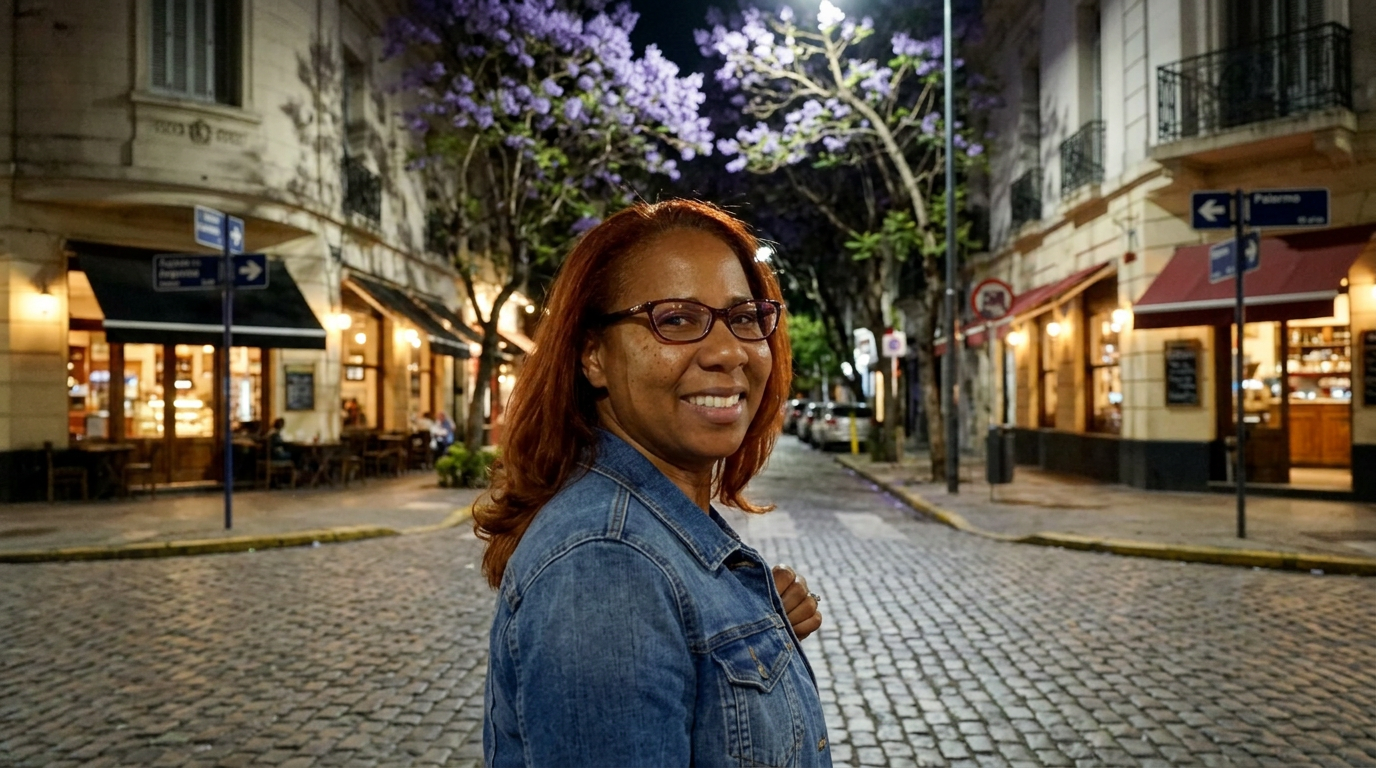
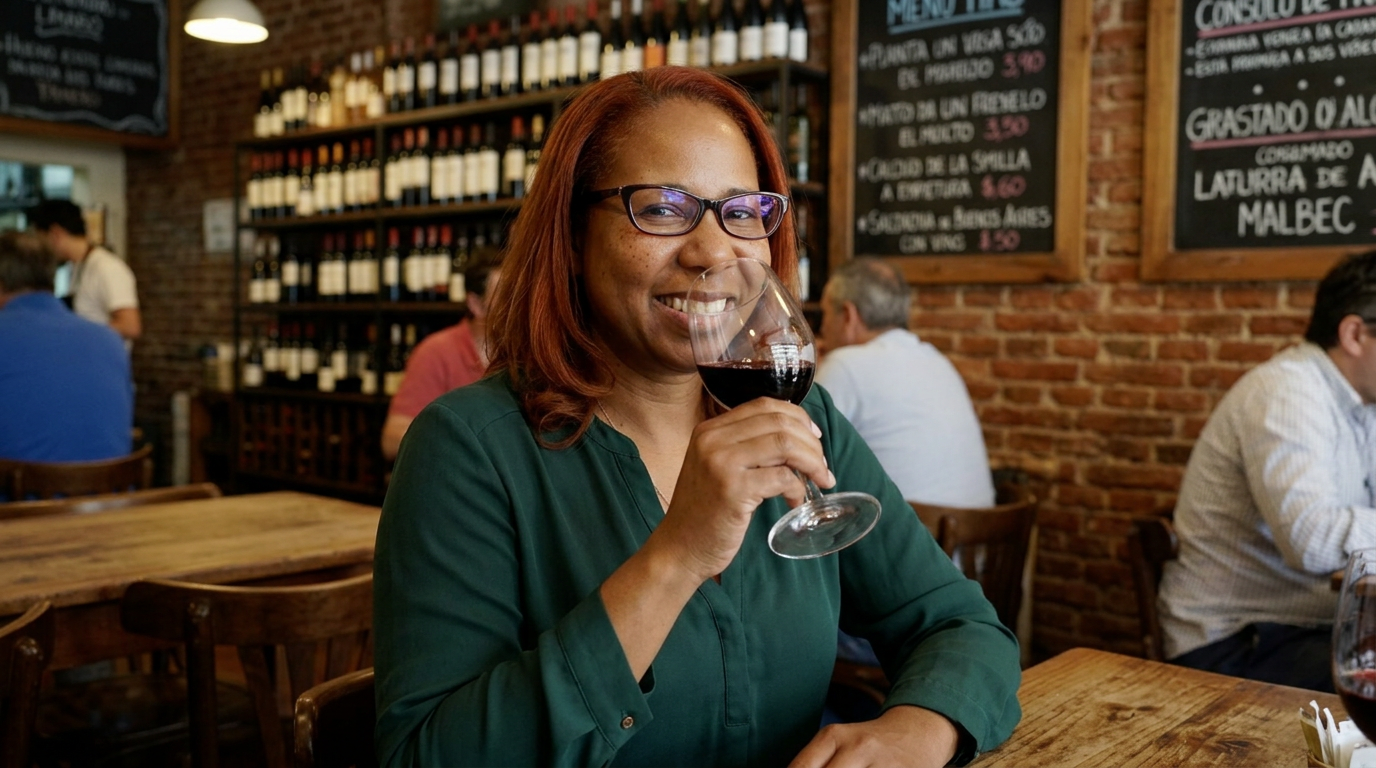
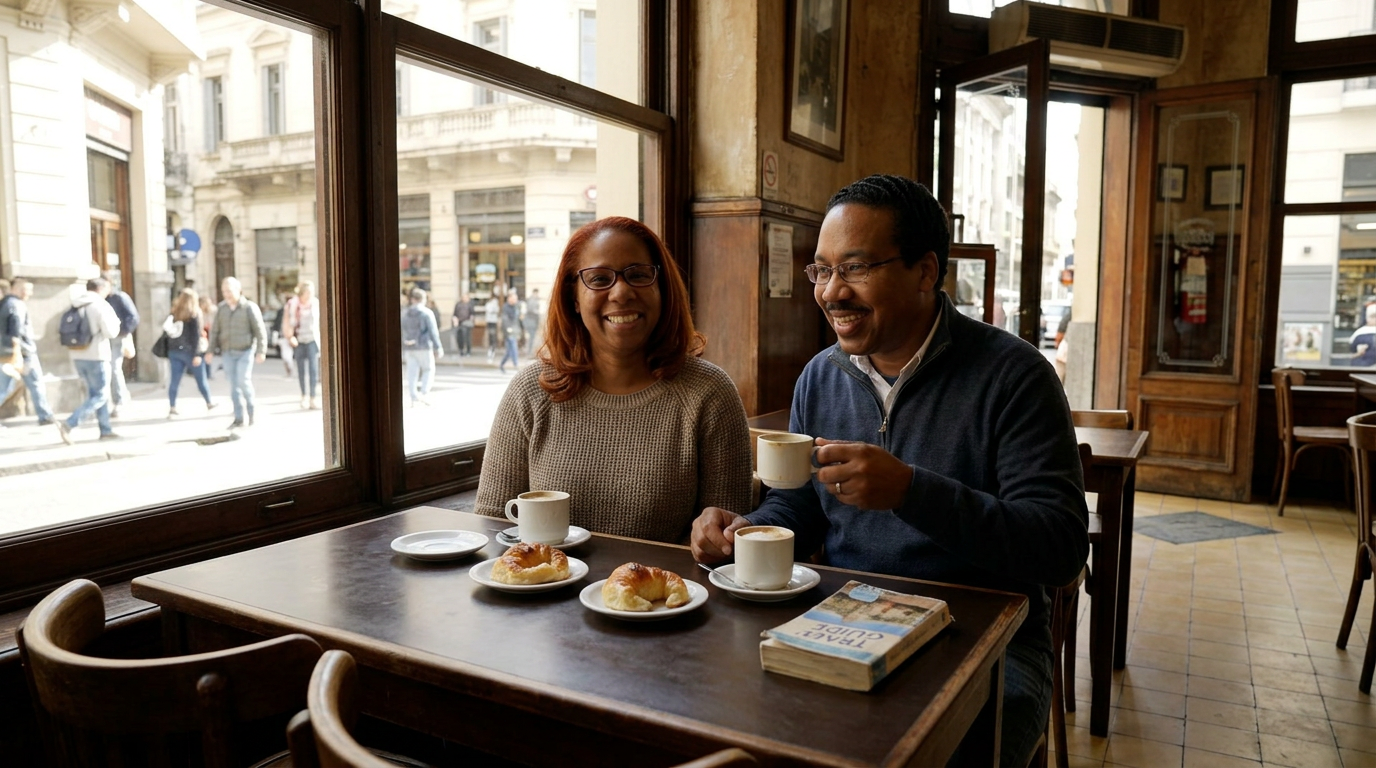
It is currently 1:45 AM in Buenos Aires. Back home in Orlando, I would have been asleep three hours ago, but here, the night is just getting started—and I think I finally understand this city.
Handheld, slightly shaky camera of Tara walking down a dimly lit, tree-lined street in Palermo Soho. The warm glow of streetlights filters through the jacaranda trees, and laughter from a nearby sidewalk cafe drifts into the microphone.
I have to admit, when Tony and I first landed at Ezeiza International Airport after an eleven-hour overnight flight, I was completely intimidated. I had my trusty canvas backpack, my worn-out sneakers, and a massive dose of imposter syndrome. Buenos Aires is famous for its grand European architecture, its impossible elegance, and a daily schedule that defies everything my internal clock stands for. They don't even think about dinner here until 10:00 PM. As someone who loves an early night, I was genuinely nervous about whether I could keep up.
We checked into our small boutique hotel in Palermo Soho around noon. It cost us about 65,000 Argentine Pesos a night—which is roughly 75 US dollars—and my first instinct was to take a massive nap. But the afternoon sun was hitting the cobblestones just right, and the smell of roasting espresso from the cafe downstairs was too pulling to ignore. I threw on a light denim jacket, grabbed my camera, and resolved to stay awake.
Our afternoon started with a walk down to the historic San Telmo neighborhood. We took the Subte—the local subway system—which is incredibly cheap at less than a dollar a ride, though we did have to ask a very patient local for help buying a SUBE transit card at a corner kiosk. San Telmo is the oldest barrio in the city, filled with crumbling colonial buildings, antique shops, and street artists. We wandered through the San Telmo Market, watching vendors polish vintage brass pocket watches and sort through stacks of old tango records. The energy was electric, a mixture of nostalgic melancholy and vibrant, modern life.
By 4:00 PM, my feet were aching and the jet lag was threatening to take over. We stopped at a tiny, crowded corner café called El Federal. It felt like stepping back into 1910, with dark wood paneling, dusty bottles of Fernet on high shelves, and waiters in crisp white aprons. We ordered a simple 'café con leche' and two warm medialunas—the local, sweeter version of croissants—for about 4,000 Pesos. Watching the locals read the newspaper and argue passionately about football over tiny cups of espresso gave me the second wind I desperately needed.
As the sun began to set, turning the sky over the Rio de la Plata a beautiful shade of dusty rose, we made our way back toward Palermo. We had a reservation at a small, low-key wine bar called Vico, recommended to us by a girl we met in the subway station. This wasn't a stuffy tasting room. It was a self-serve wine bar where you load a card and pour your own samples from automated dispensers. I was on a mission to find a real Argentine Malbec—not the heavy, oaky stuff exported to US supermarkets, but something fresh, bright, and loved by the people who actually live here.
I poured a glass of a high-altitude Malbec from the Uco Valley in Mendoza. It cost about 3,500 Pesos for a generous pour. It was a revelation. It didn't taste like vanilla or heavy wood; it tasted like fresh plums, violets, and a hint of wet earth. It was light enough to drink on a warm evening but complex enough to make you stop and look at the glass. Tony and I sat at a high wooden table, sharing a plate of local cheeses, and just watched the room fill up. By 8:30 PM, the place was buzzing, but nobody was eating dinner yet. They were just warming up.
Our actual dinner reservation at a neighborhood parrilla called Don Julio wasn't until 10:30 PM. Yes, you heard that right. We actually had to secure this booking weeks in advance, and even at that hour, there was a crowd waiting outside on the sidewalk. The smell of burning wood and sizzling beef fat hit us from a block away. The dining room was loud, chaotic, and incredibly warm, with walls lined with signed wine bottles from guests who had dined there over the decades.
We ordered a classic bife de lomo (tenderloin) to share, which cost around 32,000 Pesos, along with some grilled provolone cheese called provoleta. When the steak arrived, the waiter cut it with a spoon to show how tender it was. It was, without exaggeration, the best piece of beef I have ever tasted in my life. We paired it with a bottle of rustic, unfiltered Cabernet Franc from Patagonia that the sommelier suggested in broken English. He didn't use fancy terms; he just smiled, tapped his chest, and said, 'This has the soul of the south.' He was right.
B-roll of the sizzling open grill at the parrilla, the waiter cutting steak with a spoon, close-ups of red wine swirling in a glass, and the vibrant night crowds on the streets of Palermo.
By the time we walked out of the restaurant, it was past midnight. In any other city, the streets would be emptying out, but here, families with young children were just arriving at ice cream parlors, and groups of friends were laughing on corner steps. We walked back to our hotel under a canopy of purple jacaranda blossoms, our faces warm from the wine and the cool night breeze.
I realized then that Buenos Aires isn't a city you visit to check sights off a list. It is a city you yield to. You have to let go of your schedules, your early bedtimes, and your expectations. You have to eat when they eat, drink what they drink, and let the night carry you away. If you come here, leave your itinerary at home, book a dinner table for 10:00 PM, and just let the city show you who she is.
Tara looks directly at the camera, smiling tiredly but happily under the warm streetlights of Palermo. She raises a small paper cup of dulce de leche ice cream in a silent toast to the camera as the scene fades to black.
Shot List
| Type | Description | Audio | Duration |
|---|---|---|---|
| Wide | Establishing shot of the grand, European-style apartment buildings of Buenos Aires under a bright blue afternoon sky. | Ambient city sounds: distant traffic, faint Latin music, and birds chirping. | 5s |
| Medium | Tara, wearing a denim jacket and a small black backpack, walking down a tree-covered cobblestone street in Palermo Soho. | Tara (VO): 'They call this the Paris of South America, but within ten minutes of arriving, I realized it has a heartbeat entirely its own.' | 7s |
| Detail | Close-up of a SUBE transit card being tapped against a yellow subway turnstile reader. | A sharp electronic beep followed by the clanking metal of the turnstile. | 3s |
| B-roll | POV shot from inside a vintage wooden Subte train car as it rattles along the tracks, passengers chatting nearby. | Rhythmic clattering of train wheels on tracks and soft murmurs of Spanish conversation. | 6s |
| Wide | The bustling interior of the San Telmo Market, with natural light streaming through a historic glass-and-iron ceiling. | Tara (VO): 'Our first stop was San Telmo, the city\'s oldest neighborhood, where the past feels completely alive.' | 8s |
| Close-up | A vintage record player spinning an old tango vinyl inside an antique stall. | Faint, scratchy tango music playing from the record. | 5s |
| Medium | Tara and Tony sitting at a dark wooden table in El Federal, a historic cafe. Tony is smiling as Tara takes a bite of a small medialuna. | Tara: 'Oh wow, it\'s sweeter than a regular croissant. It\'s almost like a brioche glaze. It\'s perfect.' | 8s |
| Detail | Red wine pouring from an automated dispenser at Vico Wine Bar into a large, elegant glass held by Tara. | The low hum of the wine dispenser followed by the soft splash of liquid in the glass. | 4s |
| Close-up | Tara swirling her glass of Malbec against the warm ambient lighting of the wine bar, looking at the deep ruby color. | Tara: 'This is nothing like the heavy Malbecs I buy at home. It\'s bright, it\'s fresh... it actually tastes like spring.' | 7s |
| Overhead | A sizzling plate of grilled provolone cheese (provoleta) bubbling on a rustic wooden table next to a glass of red wine. | Loud, satisfying sizzle of hot cheese. | 5s |
| Medium | A waiter at Don Julio Parrilla expertly slicing a thick bife de lomo steak using only a metal spoon to demonstrate its tenderness. | Clinking of plates, loud restaurant chatter, and Tara off-camera gasping slightly in surprise. | 6s |
| Detail | Tara taking a bite of the steak, closed eyes, nodding her head in pure culinary bliss. | Tara: 'Unbelievable. It literally melts. You don\'t even need a knife. I get the hype now.' | 6s |
| Timelapse | A busy street corner in Palermo Soho at midnight, with outdoor tables packed with people laughing and drinking. | Upbeat, late-night acoustic guitar music swelling in volume. | 8s |
| Medium | Tara walking towards the camera under the glowing purple jacaranda trees, holding a small cup of artisanal ice cream. | Tara: 'It\'s past midnight, my feet hurt, and I\'ve never felt more awake. Don\'t fight the late nights here. Just embrace them.' | 10s |
- Capture the unique texture of the historic wooden Subte train cars while they are in motion, focusing on the vintage light fixtures.
- Get close-ups of the street art and colorful murals that line the alleyways of Palermo Hollywood.
- Film the steam rising off the massive iron grill (asado) at the restaurant, showing the glowing orange wood embers underneath.
- Capture the movement of the locals walking, talking, and kissing on the cheeks as they greet each other outside bars late at night.
- 0:00 — Atmospheric, late-night acoustic guitar with a subtle Latin rhythm to set the mood of the midnight walk.
- 1:15 — Upbeat, whimsical indie-folk music as Tara and Tony navigate the subway and arrive in colorful San Telmo.
- 3:00 — Soft, nostalgic accordion melody mimicking a classic Argentine tango, playing softly in the background of the antique market.
- 5:15 — Warm, jazzy lounge music as they enter the self-serve wine bar and begin tasting the Malbec.
- 7:30 — Lively, energetic acoustic guitar with a steady beat to match the high-energy atmosphere of the crowded steakhouse.
- 9:15 — Dreamy, slow-tempo acoustic track playing as they walk back to the hotel under the stars, wrapping up the night.
- Keep the editing pace relaxed and conversational. Let the ambient sounds of the city fill the gaps between Tara's narration.
- Use warm color grading to emphasize the cozy, inviting nature of the city's nightlife and the rich colors of the red wine and steaks.
- When displaying prices or wine names, use clean, minimal hand-written style text overlays on the lower third of the screen.
- Ensure the sound design captures the clinking of wine glasses, the sizzle of the grill, and the soft chatter of the streets to make the viewer feel like they are sitting at the table.
| Call | Provider | Model | Input Tokens | Output Tokens | Compute / Credits |
|---|---|---|---|---|---|
| Script | abacus.ai | gemini-3.5-flash | 1,646 | 4,019 | — |
| Image 1 — The Late Night Walk | abacus.ai | nano_banana2 | — | — | 6,789.15 |
| Image 2 — The First Sip | abacus.ai | nano_banana2 | — | — | 6,788.65 |
| Image 3 — The Historic Cafe | abacus.ai | nano_banana2 | — | — | 6,846.55 |
I Did Sydney's Best Coastal Walk at Dawn (And Ended Up at a Hidden Wine Bar)
I started my day watching the sunrise over the Pacific on the Bondi to Coogee coastal walk, and ended it sipping Hunter Valley Semillon in a tucked-away alleyway bar in the Rocks.
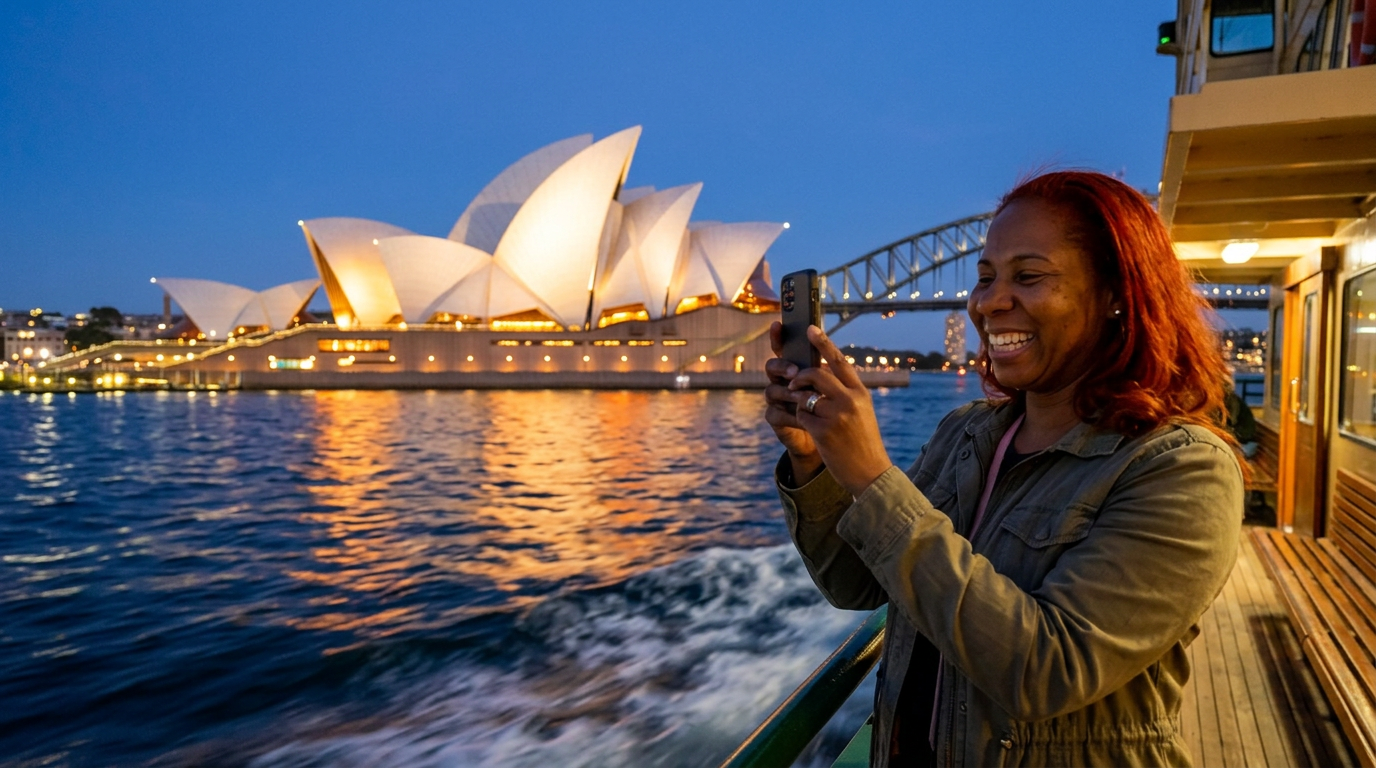
They told me Sydney was all about the harbor, but I found its real soul on a sandstone cliff at 6:00 AM, holding a flat white that was far too hot, watching the Pacific Ocean crash into a saltwater pool.
Handheld shot walking along the wooden boardwalk at Bronte Beach, camera catching the golden pink sunrise over the ocean, then panning to Tara taking a sip from a paper coffee cup.
Tony and I landed at Kingsford Smith Airport after a grueling fifteen-hour flight from Los Angeles. We were exhausted, our internal clocks were completely scrambled, and our home base of Orlando felt a million miles away. I had this grand, ambitious plan for our first full day: I wanted to tackle the famous Bondi to Coogee coastal walk at absolute dawn to beat the crowds, and then somehow transition into exploring Sydney’s legendary food and wine scene by afternoon. To be honest, as we checked into our tiny hotel in Chippendale, I was nervous that the jet lag would win and we’d end up asleep by noon.
The weather forecast wasn't helping either. It predicted a blustery, overcast day with a fifty percent chance of rain. When my alarm went off at 5:00 AM, the air was a crisp fifty-eight degrees Fahrenheit. I huddled into my favorite denim jacket, threw on my worn-in sneakers, and grabbed my small canvas backpack containing nothing but a water bottle, my camera, and a backup battery. Tony decided to sleep in and catch up with me later, so I was on my own for the sunrise trek.
Getting out to Bondi from central Sydney at that hour is a test of faith. I stumbled into the quiet street, caught the T4 train from Central Station to Bondi Junction for about four dollars and eighty cents Australian, and then hopped on the 333 bus. By the time the bus rattled down the hill toward Bondi Beach, the sky was turning a bruised, beautiful purple. The beach was empty except for a handful of incredibly fit locals in thick wetsuits, carrying surfboards toward the dark water. I felt entirely out of my depth, a sleepy American tourist trying to blend into a city that wakes up with the sun.
I started the walk at the iconic Bondi Icebergs pool. Watching the massive ocean waves swell and crash right over the concrete edge into the pool was mesmerizing. I paid nine dollars Australian to get onto the viewing deck just to watch the swimmers. It was freezing, but they didn't seem to care. From there, the paved yellow sandstone path hugs the cliffside. The wind was whipping my hair everywhere, and my camera lens kept getting misted with salt spray, but the sheer scale of the cliffs was breathtaking. I passed Tamarama Beach, which the locals call 'Glamarama' because it is so pristine, and then made it to Bronte Beach.
At Bronte, I found a tiny kiosk called the Bogey Hole Cafe. I ordered a flat white and a toasted banana bread with salted butter for twelve dollars Australian. I sat on a wet wooden bench, my hands wrapped around the warm cup, watching a local dog chase seagulls. That was the moment the jet lag finally cracked, and I realized I was actually in Australia. The air smelled like eucalyptus and sea salt, a combination I've never experienced anywhere else.
By 10:30 AM, I had walked about six kilometers and finished the trail at Coogee Beach. My legs were heavy, but the clouds had parted into a brilliant, warm blue sky. I caught an Uber back to the city center to meet up with Tony at Circular Quay. The harbor was dazzling. The Sydney Opera House looked smaller than I expected from a distance, but up close, the tiled sails are incredibly intricate. We walked through the Royal Botanic Garden, taking in the bizarre sights of giant sulfur-crested cockatoos casually hanging out in the trees like common pigeons.
For lunch, we wanted something authentic but away from the tourist traps of the Quay. We walked up into The Rocks, Sydney’s oldest neighborhood, with its historic cobblestone lanes and sandstone pubs. We found a tiny place called the Lord Nelson Brewery Hotel. It’s Australia’s oldest continually licensed pub. The room was loud, smelling of rich malt and old wood. We ordered two classic meat pies with mushy peas and gravy, which cost us twenty-eight dollars Australian each. It was heavy, savory, and exactly what my tired body needed. The pastry was so flaky it got all over my shirt, but I didn't care.
After lunch, we wandered down into a narrow, shaded alleyway called Kendall Lane and stumbled upon a beautiful, low-lit wine bar called The 1880 Souterrain. This was my goal for the afternoon: to taste some proper Australian wine. I’m no wine expert, but I know what I like, and I wanted to try something regional. The bartender, a incredibly friendly guy named Liam, suggested a glass of Hunter Valley Semillon from Tyrrell's, priced at fifteen dollars Australian.
He explained that the Hunter Valley is just a few hours north of the city and is famous for this specific white grape. When he poured it, it looked almost clear like water. But the smell was intense—like fresh lemons and wet slate. On a warm afternoon, after walking miles of coastline, it was incredibly crisp and acidic, almost vibrating on the tongue. It didn't taste like any Chardonnay or Sauvignon Blanc I'd had at home; it had this clean, mineral quality that felt like the ocean breeze I'd been walking through earlier.
Tony joined in and ordered a glass of Shiraz from the Barossa Valley, which was rich, dark, and tasted like crushed black pepper and plums. We sat on mismatched velvet stools under the exposed brick arches, chatting with Liam about how the neighborhood used to be a rough settlement for convicts in the nineteenth century. Now, it was this peaceful pocket of culture. We lost track of time, watching the sunlight slowly retreat up the sandstone walls of the alleyway outside.
B-roll of the Bondi coastal path, waves crashing, close-ups of the meat pie at the pub, pour shots of the pale Hunter Valley Semillon in the dimly lit brick wine bar, and street scenes of The Rocks.
As the evening settled in, we took a ferry from Circular Quay over to Manly just to see the city skyline light up from the water. It cost us about nine dollars and sixty cents each on our Opal cards, and it is honestly the best budget cruise in the world. The wind on the outdoor deck was freezing, but watching the Sydney Harbour Bridge and the Opera House glow gold against the dark water was unforgettable.
If you are planning a trip to Sydney, don't sleep in. Force yourself to get up for that sunrise coastal walk, even if you are exhausted. The city is at its most magical when the light is just hitting the sandstone cliffs. And when you get tired, bypass the flashy harbor-front restaurants and find a quiet alleyway in The Rocks for a glass of Semillon. It’s a taste of the land just beyond the city limits, served in the very place where Sydney's modern story began.
We headed back to our hotel, our feet aching and our faces sunburnt, but completely in love with this harbor city. Sydney isn't just about iconic landmarks; it’s about the way the wild coast and the historic streets wrap around each other, welcoming anyone willing to wake up early enough to see it.
Medium shot of Tara and Tony standing at the back of the Manly Ferry, the illuminated Sydney Opera House and Harbour Bridge receding in the background as the ferry moves across the dark water.
Shot List
| Type | Description | Audio | Duration |
|---|---|---|---|
| Wide | The sun rising over the Pacific ocean, casting a pink and orange glow over the Bondi Icebergs pool. | Ambient sound of crashing waves and distant seagulls. | 5s |
| Medium | Tara, wearing a denim jacket, walking along the Bondi sandstone coastal path, looking out at the ocean. | TARA (VO): They told me Sydney was all about the harbor, but I found its real soul on a sandstone cliff at dawn. | 6s |
| Close-up | A steaming flat white coffee cup held in Tara's hands against the backdrop of Bronte Beach. | TARA (VO): ...holding a flat white that was far too hot, watching the Pacific Ocean crash into a saltwater pool. | 5s |
| Medium | Tara talking directly to the camera on a windy cliff path, hair blowing across her face. | TARA: We landed yesterday from Orlando, absolutely jet-lagged. But I forced myself out of bed at five this morning because I had to see this coast. | 8s |
| B-roll | A surfer walking down the mossy stone steps into the ocean at Tamarama Beach. | TARA (VO): The surfers were already out in the freezing morning water. It made me feel incredibly lazy, but so inspired. | 5s |
| Detail | A knife cutting through a hot, flaky meat pie at the Lord Nelson Brewery, gravy spilling out onto the plate. | TARA (VO): By lunchtime, Tony met up with me in The Rocks. We found Australia's oldest pub and ordered these massive, flaky meat pies. | 6s |
| Medium | Tara eating the meat pie at a wooden table inside the rustic, historic pub, laughing as pastry crumbs fall. | TARA: This is messy, heavy, and exactly what my body needs right now. It is incredible. | 7s |
| B-roll | Walking shot moving down Kendall Lane, a narrow brick-paved alleyway with historic sandstone walls. | TARA (VO): Afterward, we wandered away from the busy harbor into a quiet, shaded alleyway. | 5s |
| Close-up | A glass of very pale, clear Hunter Valley Semillon being poured from a bottle at the brick bar inside The 1880 Souterrain. | TARA (VO): We found a hidden cellar bar and ordered a glass of local Hunter Valley Semillon. | 6s |
| Medium | Tara taking a sip of the white wine, looking surprised and pleased, talking to the camera. | TARA: Oh wow. It looks like water, but it tastes like pure lemon and wet stones. It is so crisp, it practically cuts right through the heat of the day. | 9s |
| Overhead | The wine glasses, a small plate of olives, and a map of Sydney resting on a rustic wooden table in the dimly lit bar. | TARA (VO): We sat there for hours, just listening to the bartender tell stories about the old convict days of this neighborhood. | 5s |
| Timelapse | The view from the Manly Ferry as it leaves Circular Quay, the Sydney Opera House passing by as the sun begins to set. | TARA (VO): To end the day, we took the public ferry to Manly just to watch the city change colors from the water. | 7s |
| Medium | Tara and Tony standing together at the back of the ferry, wind blowing, smiling as the harbor bridge lights up in the background. | TARA: It is freezing out here, but look at that view. Best ten dollars we've spent all day. | 8s |
- Get close-up texture shots of the yellow sandstone rocks along the coastal path.
- Capture the steam rising from the hot meat pie in the pub to emphasize warmth.
- Film the pale color of the Semillon against a dark background to show its unique clarity.
- Take quick walking shots looking down at your feet transitioning from sand to cobblestones.
- 0:00 — Soft, ambient acoustic guitar with a slow, waking-up tempo to match the sunrise.
- 2:15 — Light, upbeat indie-folk music with gentle percussion as Tara begins walking the coastal path.
- 4:30 — Slightly jazzy, warm acoustic bass and piano as the setting transitions to the historic streets of The Rocks.
- 6:15 — Mellow, atmospheric lo-fi beats inside the dim, cozy wine bar to create an intimate mood.
- 8:00 — Swelling, cinematic indie-pop with warm synths as the ferry leaves the harbor at sunset.
- 9:30 — Gentle, reflective acoustic guitar outro as the vlog wraps up and fades to black.
- Maintain a warm, slightly desaturated color grade that emphasizes the natural sandstone and blue ocean tones.
- Keep transitions simple, using natural whip-pans or match cuts of walking instead of digital slide transitions.
- Use subtle, clean lower-third graphics to show the names and prices of foods and locations mentioned.
- Incorporate organic sound design, letting the loud crash of waves and the chatter of the pub breathe between voiceovers.
| Call | Provider | Model | Input Tokens | Output Tokens | Compute / Credits |
|---|---|---|---|---|---|
| Script | abacus.ai | gemini-3.5-flash | 1,642 | 4,033 | — |
| Image 1 — Dawn at Bondi Icebergs | abacus.ai | nano_banana2 | — | — | 6,843.3 |
| Image 2 — Alleyway Wine Tasting | abacus.ai | nano_banana2 | — | — | 6,845.85 |
| Image 3 — Manly Ferry Sunset | abacus.ai | nano_banana2 | — | — | 6,787.75 |